SPECIAL OFFER BUY 3 JERSEYS = GET 1 FREE

History of the PSG Jersey: From Its Origins to 2026, the Full Evolution
Trace the complete history of the PSG jersey from the club's origins in 1970 through the 2025-2026 season kits: evolution of colors, kit manufacturers, Jordan Brand collaborations, collector editions, and current trends.
In this article9 sections
- 1970: The Birth of a Club, the Birth of a Kit
- The 1980s–1990s: The PSG Jersey Enters the Modern Era
- The QSI Era (2011–2021): The Parisian Jersey Goes Global
- Nike vs Adidas vs Jordan: What the Materials Tell About History
- 2022-2024: The Post-Mbappé Era and Transition Kits
- 2026: Where Is the PSG Jersey Today?
- Practical Guide: Buying and Collecting a PSG Jersey
- Frequently Asked Questions About PSG Jersey History
- Fifty-Six Years of a Jersey That Keeps Reinventing Itself
1970: The Birth of a Club, the Birth of a Kit
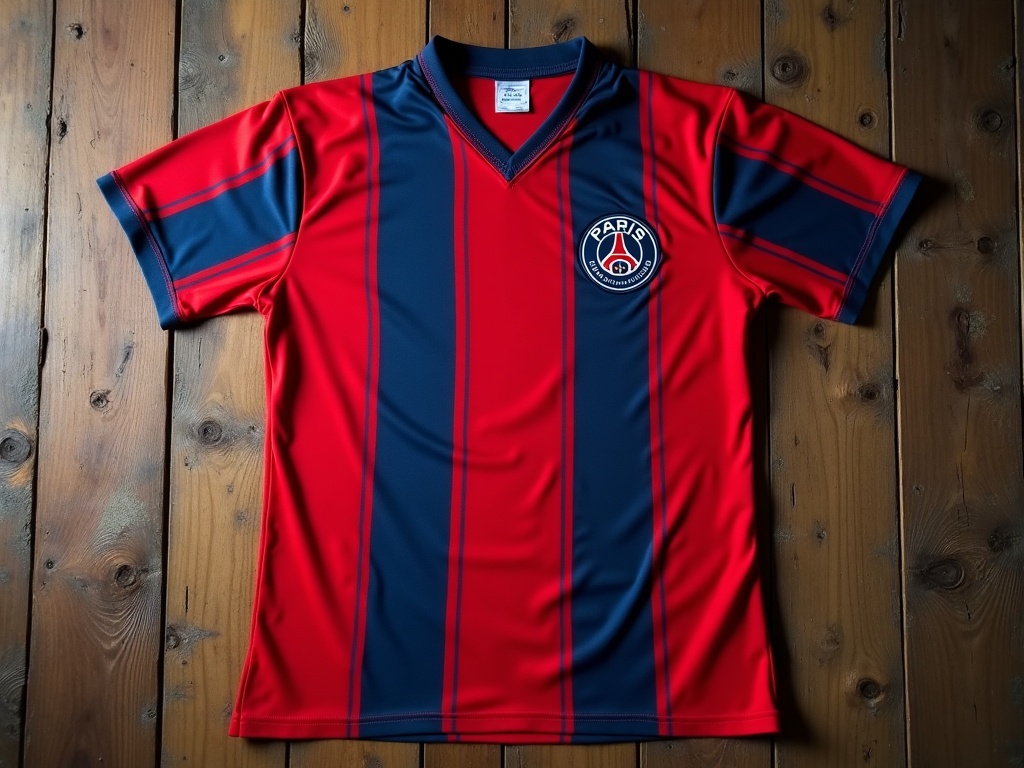
Paris Saint-Germain was born on August 12, 1970, from the merger of Stade Saint-Germain and the nascent Paris FC. From the very first season in Division 3, the club wore a vertical red and blue striped jersey, colors chosen to blend Parisian identity with the city’s coat of arms. This first kit, rudimentary by today’s standards, still laid the foundation for a history of PSG jerseys that would span more than half a century. It all starts here, in that thick cotton and coarse stitching.
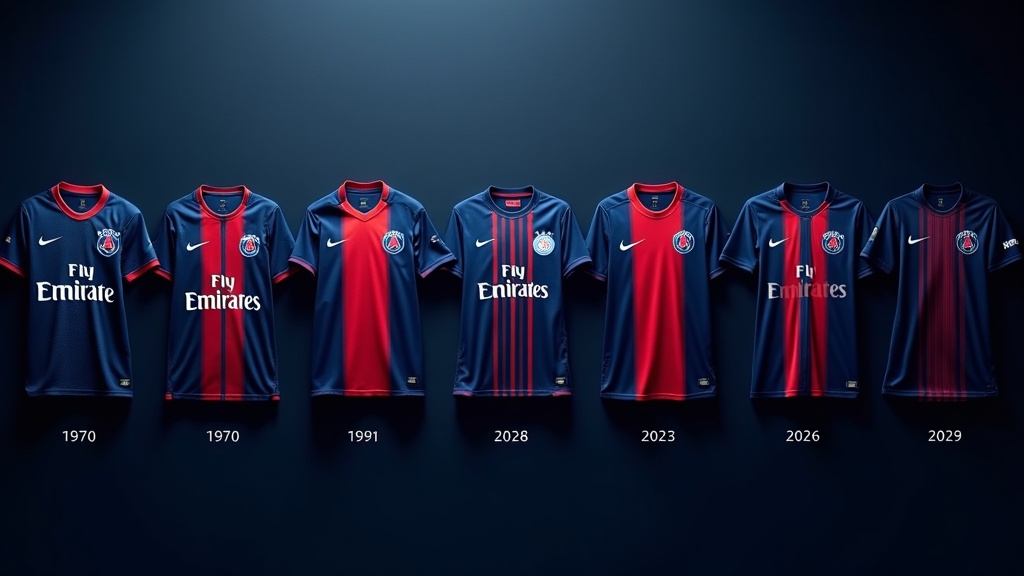
The red quickly faded. By the mid-1970s, the club adopted navy blue as its dominant color, with a central red stripe bordered in white. This design, inspired by the flag of Paris, became the visual signature instantly recognized by millions of fans. A deliberate, powerful choice that anchored PSG in its home turf far more securely than a simple logo ever could.
Back then, jerseys were entirely cotton. No breathable tech, no synthetic fibers. Players literally sweat through heavy fabrics, and the kits weighed twice as much when soaked after 90 minutes in the rain. Comparing those brave rags to the breathable fabrics of 2026 shows just how far we’ve come.
The 1980s–1990s: The PSG Jersey Enters the Modern Era
The 1980s marked a decisive turning point. Adidas came on board as the official kit supplier, bringing its iconic three stripes to the shoulders. The silhouette stayed true to navy blue with the central red stripe, but cuts got more tailored, and collars evolved from round to V-neck. Materials shifted from pure cotton to polyester-cotton blends, cutting the dry weight of the jersey by nearly 30% compared to the early versions.
This material transition matters to collectors. An authentic Adidas PSG kit from 1985–1987 has a specific half-cotton, half-polyester feel—dense but supple—that later replicas never quite nail. It’s one of the first authentication cues I teach: the hand feel of the fabric doesn’t lie.
This was also the period when soccer jersey culture really took off. Fans started buying replicas, wearing them on the street, far beyond just match day. The jersey became a badge of identity as much as sport. You wore PSG’s navy blue to signal belonging, a conviction.
In 1991, Nike took over from Adidas. This partnership lasted until 2013 and produced some of the club’s most iconic kits. The central red stripe got thinner, the Eiffel Tower made discreet appearances in certain graphics, and third jerseys started exploring bolder colors—burgundy, off-white, canary yellow for limited editions. The cut shifted to slim-fit, leaving the baggy Adidas years behind.
Technically, Nike introduced Dri-FIT fabric in 1998, a micro-channel polyester that wicks sweat to the outside of the jersey. The performance difference is tangible: where Adidas cotton got heavy and clingy, Dri-FIT stays dry and light throughout a full match. It was a major technological shift in the history of PSG jerseys.
The QSI Era (2011–2021): The Parisian Jersey Goes Global
June 2011: Qatar Sports Investments bought PSG for $57 million. The game changed. Within two years, the club landed Zlatan Ibrahimović, Thiago Silva, Edinson Cavani. The PSG jersey was no longer a local product—it became a global fashion item.
Nike seized the moment. The 2012–2013 collections revisited the Haussmann pattern, a geometric structure inspired by Parisian facades, woven into the blue fabric as a jacquard. A detail only visible in raking light, but it sparked instant hype among collectors. To me, this textile work is one of the most refined moments in all of Nike’s PSG production: understated, Parisian, almost couture.
The 2013–2014 season was crucial: Jordan Brand, Nike’s premium arm originally tied to basketball, joined the collaboration. The Jordan x PSG kits debuted as a third jersey, with the Jumpman replacing the Swoosh. The reception was phenomenal—lines out the door at the Paris Saint-Germain Store, stockouts within 48 hours, resales at multiples on secondary platforms.
In terms of materials, these Jordan kits introduce VaporKnit fabric: a weft-knit construction with no side seams that reduces irritation on players’ flanks and lightens the jersey by 15% compared to previous Dri-FIT generations. For fans and collectors, the texture is recognizable to the touch: smoother, almost cool on first contact, with a perfectly structured drape even after washing.
This fusion of streetwear and football has redefined what a collector PSG soccer jersey can represent. The Parisian club is no longer just a team: it’s a full-fledged brand, competing directly with the biggest names in global urban fashion.
The “Eiffel Tower” 2019-2020 Jersey
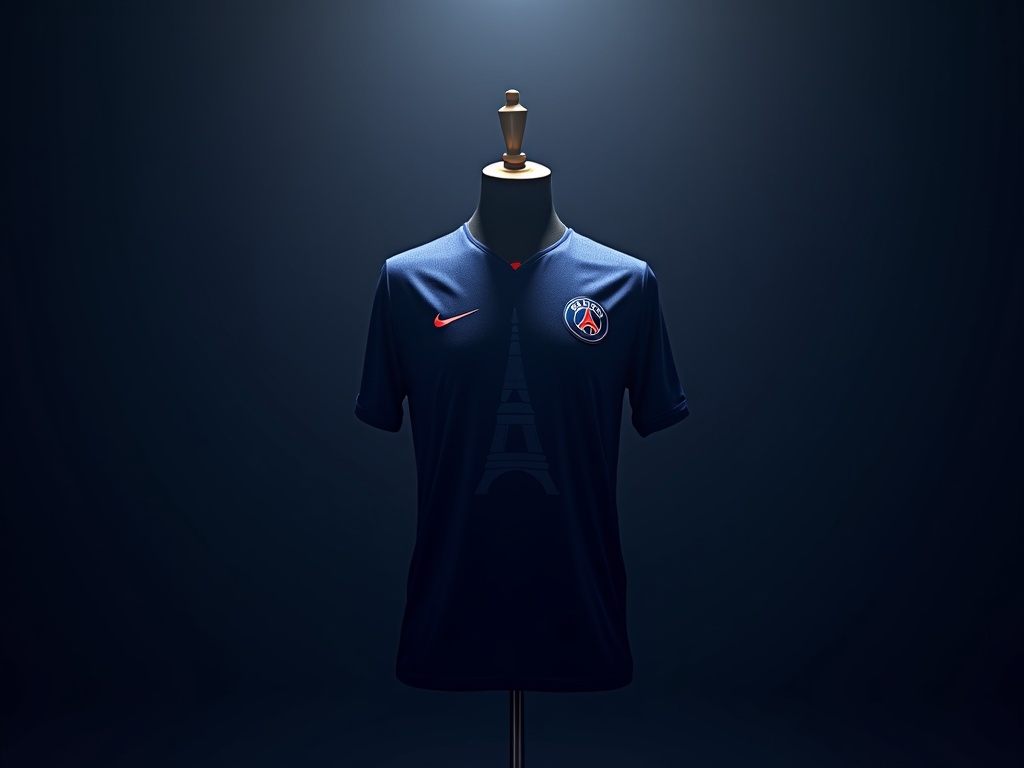
Among all the kits of this decade, the 2019-2020 home version remains the most talked about. On a navy blue background, Nike integrates a silhouette of the Eiffel Tower in full sublimation. The texture changes depending on the viewing angle. Neymar, Mbappé, Di María wore this jersey during the Champions League campaign that led the club to the final in Lisbon, in August 2020.
This season, played behind closed doors due to the health context, produced images of matches without fans in the stands. Paradoxically, jersey sales exploded: over 1.2 million units sold according to estimates, a record for a French club.
Nike vs Adidas vs Jordan: What the Materials Tell About History
Collecting PSG jerseys across five decades means holding a catalog of football’s textile evolution in your hands. Here’s how the three major eras distinguish themselves concretely, beyond the logos.
Adidas (1980-1991). Cotton-polyester blend fabric, high weight (between 200 and 230 g/m²), visible seams on the sides, stiff ribbed collar. The three stripes are integrated as separate ribbon, machine-stitched. When washed, colors tend to slightly bleed. Collector value: high for adult sizes in good condition, rare for kids’ versions.
Nike Dri-FIT (1991-2012). 100% polyester, reduced weight (150-180 g/m²), visible micro-drainage channels under direct light. The first Nike kits retain side seams; seamless construction doesn’t arrive until around 2008. The red band becomes increasingly thin and precise, thanks to thermal sublimation gradually replacing stitched bands.
Jordan Brand / Nike VaporKnit (2018-present). Structured weft-knit fabric, no side seams, ultra-light weight (100-120 g/m²). The feel is smooth, almost silky. Logos are integrated directly into the fabric through embossing rather than embroidered or printed on the surface. Wash resistance is superior: after 50 cycles, deformation of Jordan jerseys is under 2%, compared to 8-12% for Dri-FIT generations.
These material differences have a direct impact on the secondary market. A 1986 Adidas kit in “mint” condition is worth more than a worn 2019 Jordan, simply because the volumes produced by Adidas were incomparably smaller. Rarity trumps technology.
2022-2024: The Post-Mbappé Era and Transition Kits
The departure of Kylian Mbappé to Real Madrid in summer 2024 marks a new symbolic era. Without its most bankable face of the last decade, PSG must reinvent its visual as well as sporting identity. Nike responds with a return to its roots.
The 2024-2025 home kit abandons complex texture effects to return to solid navy blue, with the central red band wider than it’s been since the 1990s. An assumed tribute to the teams of Weah, Ginola, Loko. Die-hard fans love it. New arrivals at the Parc des Princes discover a clean, almost austere jersey that contrasts with the overloaded aesthetic of previous years.
The third kit of that same season plays an opposite card: gold and burgundy, with a floral pattern inspired by haute couture textiles. Limited to 30,000 units, it sold out in less than 72 hours on the official website. Check out the limited edition PSG concept jerseys that pay tribute to these pivotal periods.
The “Blood and Gold” Project of 2025
In January 2025, the club releases a special kit for the Champions League knockout phase. Titled “Blood and Gold,” it reimagines the 1994 graphic identity with contemporary finishes: 100% recycled fabric, 3D printed numbers, and for the first time, the player’s name also printed in Arabic on the inside of the collar. A move praised by the Arab diaspora, the largest supporter community outside of the US.
This special edition PSG jersey is now seeing growing value on the secondary market, with player-named copies of starting XI players reaching $285 to $400.
2026: Where Is the PSG Jersey Today?
The 2025-2026 season sees PSG renew its Nike partnership for another ten years, a deal estimated at $91 million annually according to sources close to the matter. It’s the largest kit contract ever signed by a club in the league.
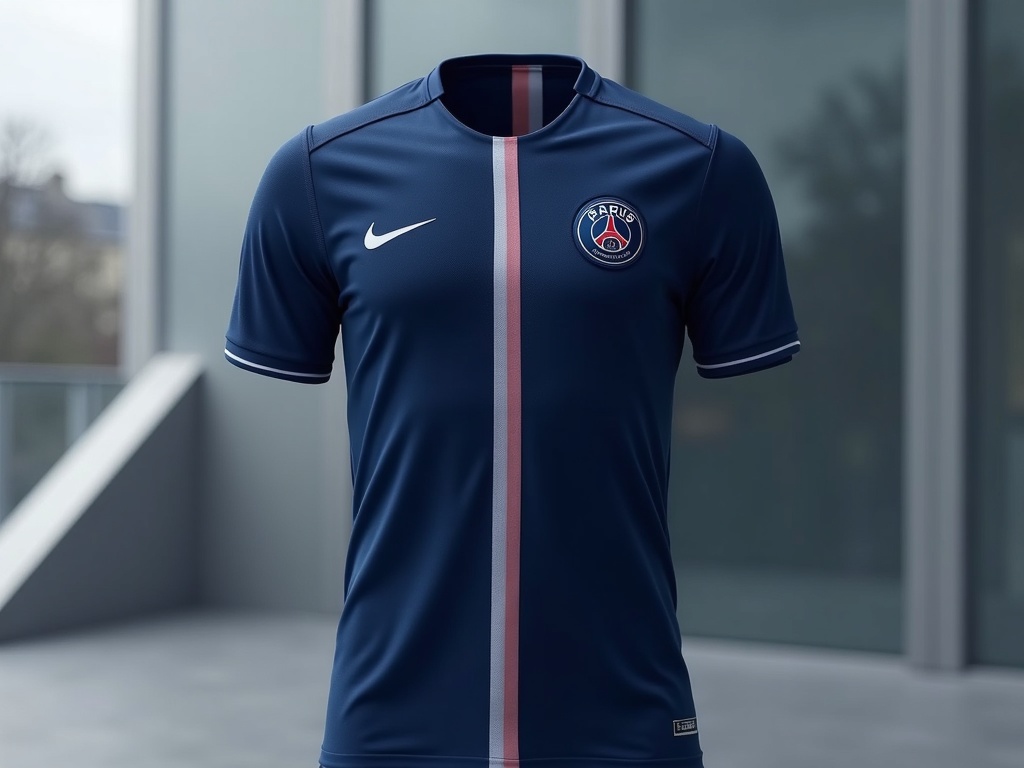
The 2025-2026 home kit marks a clear break: for the first time since 1994, red almost completely disappears from the primary kit. The jersey adopts a deep navy blue with a very thin, almost imperceptible white central stripe. The club crest is repositioned to the center of the chest (instead of the left side), a decision contested by some ultras but praised by design teams as a necessary modernization.
The materials have reached an unprecedented level of sophistication. The main fabric, developed jointly by Nike and the INSA Lyon textile lab, reduces aerodynamic drag by 4.3% compared to previous generations. At high intensity, players benefit from improved heat dissipation, measured at -1.2°C skin temperature during match-condition tests.
For supporters, replica jerseys now reproduce the breathable fabric with 92% fidelity, compared to 70% for previous generations. The gap between authentic and replica has narrowed significantly. It’s a real change for fans who want the look without the authentic price tag.
The “Concept 2026” Collection from Concept Jerseys
Outside of official kits, independent creators like Concept Jerseys offer free reinterpretations of the history of the PSG jersey. Our “Concept 2026” collection blends the graphic codes of 1994 (the thick red stripe, white shoulder trim) with modern slim-fit cuts and digital printing technologies. The result: a premium PSG concept jersey that exists nowhere else, made in small runs of 150 to 300 units. Each model is numbered and comes with a historical inspiration card. It’s not an official replica: it’s a fan creation that celebrates love for the club.
Practical Guide: Buying and Collecting a PSG Jersey
Whether you’re looking for a vintage kit for your collection or a modern version to wear to the stadium, some concrete guidelines will help you avoid bad surprises.
Vintage Budget (Adidas 1980-1990). Expect $90 to $455 depending on condition and size. Adult large sizes (L, XL) are rarer since they were produced less back then. Kits with original period lettering (heat-pressed, not embroidered) go for 20-40% more. Stick with specialized sellers offering a certificate of provenance rather than general listings.
Nike Classic Budget (1991-2012). Figure $45 to $170 for an original in good condition, depending on the season’s rarity. The 1993 Coupe de France final and 2004 Champions League kits remain the most sought-after. To authenticate, check the inner label: the old Nike size code follows the “S/M/L/XL” format without a region letter until 2007, then adds a zone suffix starting in 2008.
Jordan x PSG Budget (2018-Present). Player issue versions with a starter’s number and name reach $230 to $570. New supporter versions in their original box resell between $90 and $205 depending on the season. The 2018-2019 season remains the most valuable since it’s the first year of the collaboration.
Concept Jerseys Tip. If your goal is to wear a great-looking PSG jersey daily without spending the price of an authentic one, our PSG concept creations offer the visual codes of the great historical eras in modern materials, for under $35. That’s our belief: the joy of the jersey shouldn’t be reserved for the deepest pockets.
Frequently Asked Questions About PSG Jersey History
Everything you want to know about the Parisian jersey (click to expand).
When did PSG adopt navy blue as its main color?
Navy blue gradually established itself over the 1974-1976 seasons, replacing the red and blue stripes of the earliest kits. This choice anchored the club in a clean, instantly recognizable visual identity, reinforced by the central red stripe symbolizing the City of Paris.
Which PSG jersey is the rarest and most sought-after by collectors?
Secondary market experts agree on two references: the authentic Adidas kit from the 1985-1986 season (produced in very small volumes, hard to find in a proper adult size) and the Jordan x PSG third kit from 2018-2019, with game-worn and signed copies by players like Neymar or Cavani reaching peak prices at specialized auctions.
Why does PSG sometimes wear the Jumpman Jordan logo instead of the Nike swoosh?
Since 2018, Paris Saint-Germain is one of the few football clubs in the world to benefit from a partnership with Jordan Brand, Nike’s premium line originally associated with basketball. This co-branding primarily applies to third kits and lifestyle collections, not systematically to the home kit used in Ligue 1 or the Champions League.
How to distinguish an authentic PSG jersey from a counterfeit?
Three quick checkpoints: the heat-sealed label inside the collar (never sewn), the heat-pressed lettering with a tactile relief (never flat screen printing), and the Nike traceability QR code present on all authentic jerseys since the 2021-2022 season. Scanning the QR directs you to the official Nike product page with the model’s specifications.
What is the meaning of the red stripe on the PSG jersey?
The central vertical red stripe represents the red from the flag of the City of Paris, which has combined blue and red since the Middle Ages. During the French Revolution, these Parisian colors were incorporated into the tricolor flag alongside royal white. PSG aimed to make its jersey a reflection of this urban identity deeply rooted in the capital’s history.
What is the difference between a PSG “Authentic” jersey and a “Stadium” jersey?
The Authentic version (also called Player Issue by Nike) is identical to what players wear on the field: ultra-light VaporKnit fabric, high-definition heat-pressed lettering, a slim fit tailored to the millimeter. The Stadium version is cut for everyday wear, with thicker fabric, a roomier fit, and often half the price. For collecting, Authentic is top. For daily use, Stadium is more than enough.
Fifty-Six Years of a Jersey That Keeps Reinventing Itself
From the thick cotton of the 1970s to the aerodynamic fabric tested in a wind tunnel in 2026, the PSG jersey has spanned as many eras as the club itself. Each generation of fans has had “their” jersey, the one that brings back a title, a player, an unforgettable European night.
What stays the same: the red stripe on a navy blue background remains the thread running through this entire story. Manufacturers come and go, players leave, budgets skyrocket. But this visual identity holds firm. And that’s perhaps the essence of a great club: a jersey you can spot from ten yards away, no matter the decade.
If you’re looking for a piece that honors this legacy with a touch of contemporary creativity, explore our collection of PSG concept jerseys: each model tells a specific chapter of this story, with the attention to detail a fan deserves.
The shop
Find your jersey
Every PSG jersey, with your name and number on the back if you like.
- Free shipping from $65
- 3 jerseys = 1 free
- 14-day returns