SPECIAL OFFER BUY 3 JERSEYS = GET 1 FREE

Chelsea Jersey History: How the Blues’ Kit Became an Icon
From the washed-out cotton blues of the 1950s to the precision-engineered match jerseys of the 2020s, Chelsea's kit history runs deeper than most fans realize. This article traces every major era, the design choices that defined them, and what makes certain vintage Blues shirts so prized by collectors today.
In this article10 sections
- The Founding Era: Chelsea Kits from 1905 to the 1950s
- The 1960s and 1970s: Royal Blue Cotton at Its Peak
- The 1980s Transition: Le Coq Sportif and Umbro Take Over
- The 1990s: Chelsea’s Most Collectible Jersey Decade
- Fila, Umbro Return, and Adidas: 2000 to 2015
- How Chelsea’s Badge Has Shaped Its Jersey Identity
- Era-by-Era Chelsea Kit Comparison
- What Serious Collectors Actually Look For in Chelsea Vintage Shirts
- Frequently Asked Questions about Chelsea Jersey History
- The Fabric Behind the Club: Why Chelsea Kit History Keeps Drawing People Back
Chelsea jersey history stretches back to 1905, and if you hold an original 1970s royal blue cotton shirt up to morning light, you can feel exactly why the club’s identity is sewn into the fabric. Not a marketing slogan. The actual weight of the cloth, the loose weave, the slight fade at the collar: it all tells a story that no amount of replica printing can fake.
I remember the first time I held a genuine 1970s cotton Chelsea home shirt at a specialist dealer in Portobello Road. That flutter in my chest was immediate: heavier than expected, the royal blue deeper and more textured than any photo had suggested, the Admiral sleeve stripe still crisp against the worn cotton. That physical encounter is what separates collectors who understand Chelsea kit history from fans who merely follow it.
The Blues have worn royal blue for most of their existence, but what sits under that color has changed dramatically. Cotton gave way to nylon, nylon to polyester, polyester to the kind of engineered mesh that breathes differently depending on which panel you press between your fingers. Understanding those shifts is how you know whether a vintage shirt you’re looking at is worth the price asked for it.
The Founding Era: Chelsea Kits from 1905 to the 1950s
Chelsea Football Club was formed in 1905, and their first kits were heavy cotton working-dress strips with minimal branding, a Pensioner crest, and a lighter royal blue that faded to near sky-blue over time, which is exactly what makes authenticated early shirts so rare and so prized today.
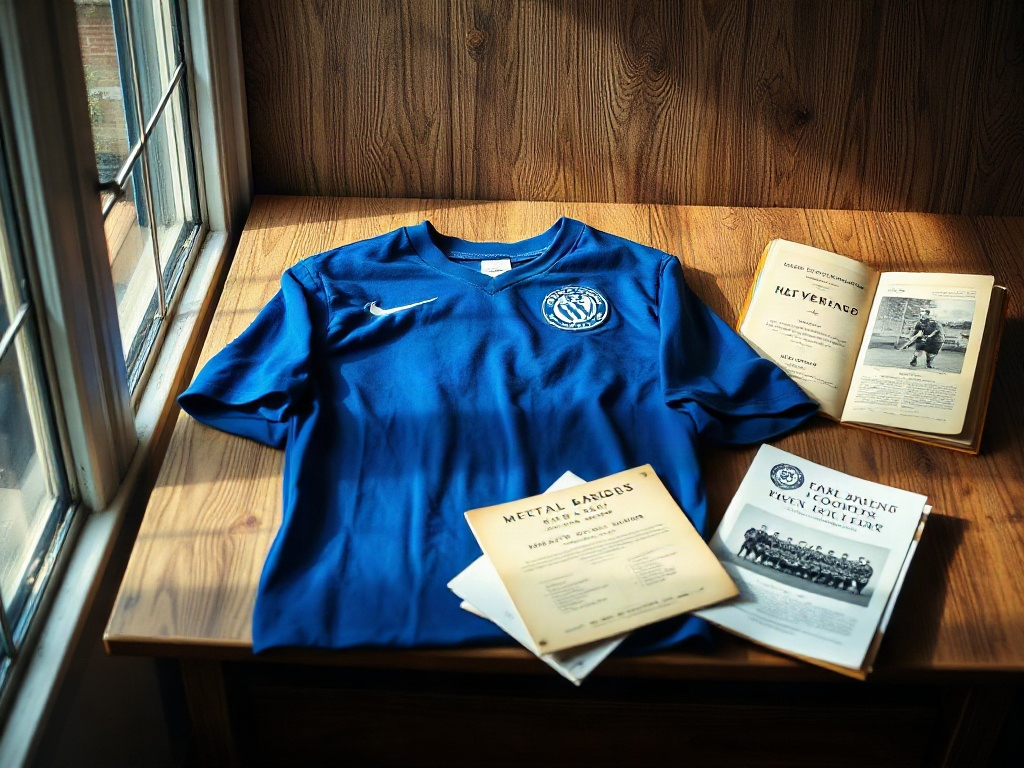
Chelsea Football Club was formed in 1905, and their early kits were straightforward working-class kit. Heavy cotton, simple cuts, a strip that looked a lot like what every other club was wearing at the time. The badge in those early decades was minimal: a pensioner figure (the Chelsea Pensioner, a retired soldier from the Royal Hospital nearby) sat on the chest in the club’s first official crest design.
The exact shade of blue in this era leaned lighter than what we think of as Chelsea blue today. Cotton fabrics didn’t hold dye the way synthetic materials do, so shirts from the 1930s and 1940s often appear almost sky blue in photographs. That fading is part of their appeal to collectors. A shirt from that period that still holds a deep royal blue has likely been stored unusually well, and is worth scrutinizing for authenticity.
Away kits in this period were functionally white, with minimal branding. The concept of away kits as collector pieces came much later. For now, the home shirt was the statement.
The 1960s and 1970s: Royal Blue Cotton at Its Peak
The 1960s and 1970s Chelsea home shirt in heavyweight royal blue cotton remains the benchmark for the entire Chelsea jersey history: fabric weights between 200 and 250 gsm, block-printed squad numbers, and a construction that absorbs every weather condition Stamford Bridge could throw at it.
This is the era that collectors return to most reliably. The 1960s and 1970s Chelsea home kit in royal blue heavy-weight cotton is the shirt that most people picture when they think of classic Blues football. The cut was simple and boxy by modern standards, the collar was either a round neck or a simple V, and the number on the back was a block printed white digit, not embroidered.
What makes these shirts exceptional to handle is the fabric weight. Shirts from this period typically ran between 200 and 250 grams per square meter, noticeably heavier than any modern match shirt. When Peter Osgood pulled one on at Stamford Bridge in the early 1970s, he was wearing something that absorbed sweat, got heavier in the rain, and showed every slide tackle. That’s not a flaw. That’s a document.
The Admiral brand partnership began in 1975, and that shift brought the first commercial branding onto Chelsea shirts: the Admiral logo on the sleeve, and a slightly updated badge application. It’s a turning point in the Chelsea FC kit evolution from purely functional sportswear to commercial product.
👕
1970s-Style Chelsea Royal Blue Cotton Replica
240 gsm cotton construction, block-print white squad number, V-neck collar. The closest modern recreation of the shirt Peter Osgood wore at Stamford Bridge.
View this kit
The 1980s Transition: Le Coq Sportif and Umbro Take Over
The 1980s gave Chelsea two underrated manufacturers: Le Coq Sportif from 1981 to 1986 with its longer body and structured collar, and Umbro from 1987 with a cotton-polyester blend that bridged the gap between old-school fabric and modern performance, creating shirts that remain among the best-value collector finds on the secondary market today.
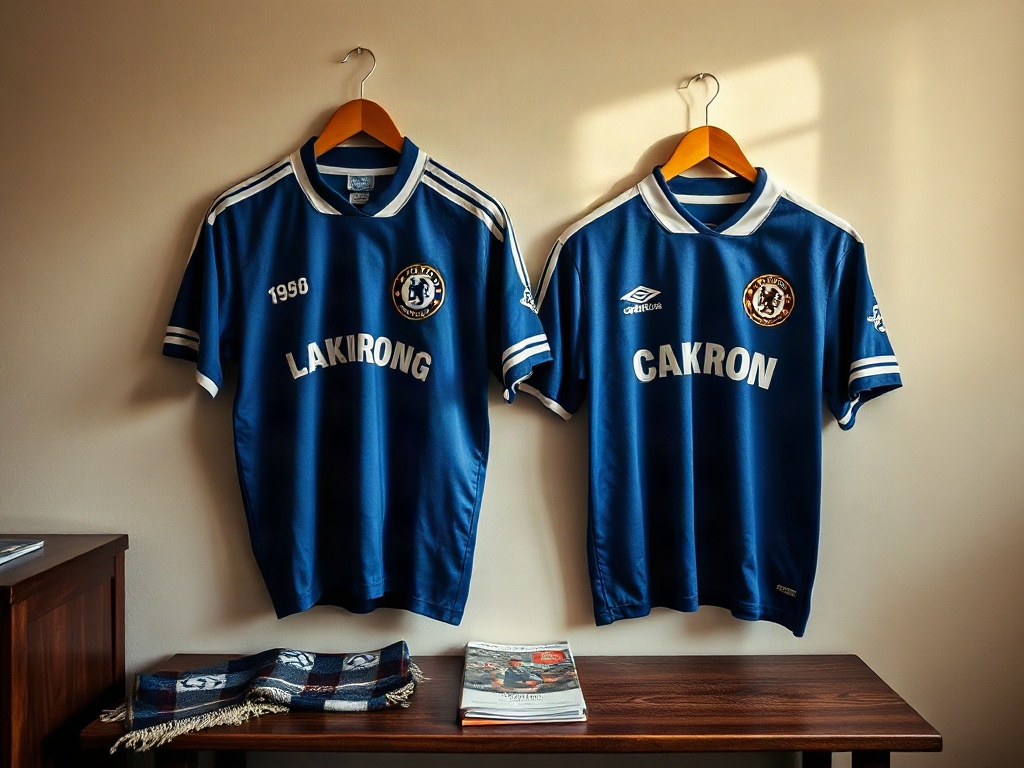
Le Coq Sportif supplied Chelsea from 1981 to 1986, and their jerseys have a distinctive cut: slightly longer in the body than Admiral’s, with a more structured collar and a cleaner chest. These shirts are criminally underrated on the secondary market. Collectors often skip straight to the 1990s Umbro era, which means good Le Coq Sportif Chelsea shirts still turn up at prices that make sense.
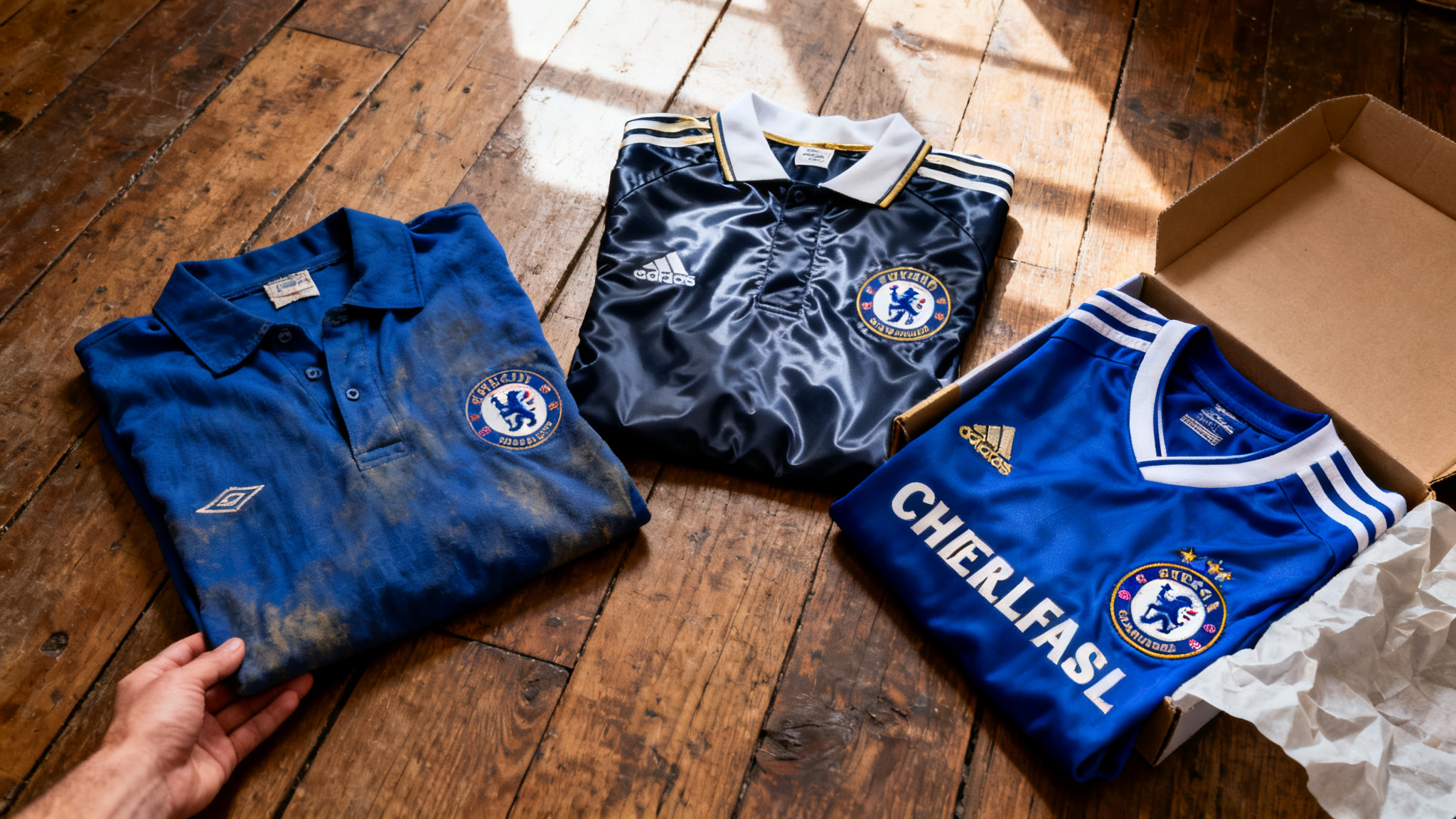
Umbro arrived in 1987 and stayed through to 1994. The late 1980s Umbro home shirt is one of the more interesting pieces in Chelsea kit history because it caught the transition between old-school cotton blends and modern polyester. The 1989-91 home shirt used a cotton-polyester mix that gave it a slightly silkier feel than pure cotton, while keeping the color depth that pure polyester struggles with in this period.
Away kits in the 1980s got genuinely creative. Chelsea’s yellow away shirts from this decade are proper collector pieces, representing a willingness to move away from white that the club has rarely matched since. The 1981-83 yellow away in Le Coq Sportif fabric is the one to hunt for.
The 1990s: Chelsea’s Most Collectible Jersey Decade
The 1990s produced the most sought-after shirts in Chelsea jersey history: the 1997-99 tangerine and graphite Umbro away worn by Gianfranco Zola and Roberto Di Matteo is the decade’s crown jewel, but the full run from 1990 to 1999 contains something for every budget and every taste.
The early 1990s Umbro strips are where Chelsea kit history gets genuinely exciting for collectors. The 1993-95 home shirt, with its simple design and bold royal blue polyester, marked the beginning of Chelsea’s rise toward Premier League prominence. Then came the Ruud Gullit era, and with it a series of kits that matched the ambition happening on the pitch.
The 1997-99 Umbro away shirt in a striking tangerine and graphite colorway is probably the most talked-about vintage Chelsea away jersey in collector circles. It divided opinion at the time, which is precisely why it reads as bold and confident three decades on. Worn by Gianfranco Zola and Roberto Di Matteo, it captures a specific moment when the club started importing continental quality and letting it show in every detail.
👕
1997-99 Chelsea Tangerine Away Shirt
Umbro-era construction, tangerine and graphite colorway, period-correct woven badge application. The most debated design in Chelsea kit history and the one every serious collector wants.
View this kit
Autograph and name-and-number printing on the back became standard through this decade. Early Premier League-era Chelsea shirts with original squad numbers, particularly from the 1997-98 squad, carry a significant premium. The font used by Umbro for Chelsea namesets in this period has its own collector following: a clean, wide letterform that reads well from the stands.
- 1990-92: Umbro home, traditional royal blue, classic cut, clean white collar
- 1993-95: Transition to the modern crest, polyester construction, lighter weight
- 1995-97: Autographed squad shirt versions command the highest prices from this era
- 1997-99: Tangerine away shirt (one of the most debated designs in club history)
- 1999-2000: Fila takeover, the beginning of a short but distinctive chapter
Fila, Umbro Return, and Adidas: 2000 to 2015
From 2000 to 2015, Chelsea cycled through Fila, a returning Umbro, and finally Adidas: three distinct manufacturer voices that tracked the club’s rise from ambitious project to serial European contender, with each partnership leaving at least one genuinely collectible design in its wake.
Fila supplied Chelsea from 1999 to 2004. Their jerseys split collectors cleanly in two camps: those who love the slightly Italian cut and the bold template use, and those who found their Chelsea applications bland compared to what Umbro had been doing. The 2002-03 home shirt in particular is a clean, unfussy royal blue with the Fila wordmark sitting small on the left chest. It’s aged well.
Umbro returned for a second stint from 2006 to 2012, overlapping with the club’s Roman Abramovich-era peak. Their 2009-10 away shirt in a deep navy with gold trimming is consistently among the most searched Chelsea collector kits from the 2000s. The gold accents referenced the club’s badge color and gave the strip a weight that matched the squad wearing it: Didier Drogba, Frank Lampard, John Terry.
👕
2009-10 Chelsea Navy and Gold Away Shirt
Umbro construction, deep navy with woven gold trim, Premier League patches original. Worn by Drogba, Lampard and Terry during Chelsea’s title-winning campaign. One of the most hunted Umbro-era pieces.
View this kit
Adidas took over from 2012 and introduced a template system that gave Chelsea shirts a consistent identity across their global licensing operation. The 2012-13 UEFA Champions League final shirt worn against Bayern Munich is one of the most sought-after match-worn Chelsea pieces available. The tournament patches and final printing add layers of story that make even replica versions from that season worth holding onto.
Nike signed their long-term deal with Chelsea starting from the 2017-18 season, and their approach shifted toward clean minimalism. The 2017-18 home shirt with its thin horizontal stripe pattern drew directly from 1970s club heritage, and that connection to vintage Chelsea kits made it popular on release and continues to make it wearable today without looking obviously dated.
How Chelsea’s Badge Has Shaped Its Jersey Identity
Chelsea’s crest is as central to the feel of any shirt as the fabric itself: the method of badge application shifted from woven-in construction in the 1950s and 1960s to heat-pressed embroidered patches by the 1980s, and you can read that transition with your thumb even before you check the label.
The crest is where Chelsea kit history gets underappreciated. Most fans know the basic story: Pensioner figure, then lion rampant, then the 1986 redesign that simplified the graphic, then the controversial 2005 redesign that modernized the lion for the club’s centenary.
What fewer people notice is how the application method changed the feel of the shirt. In the 1970s and earlier, the badge was often woven directly into the fabric or embroidered as a separate patch heat-pressed to the chest. By the late 1980s, Umbro and Le Coq Sportif were both using higher-quality embroidery with a thread count you could verify by feel. The badge on a mid-1980s Chelsea shirt has visible dimensionality when you run your thumb across it. On cheaper replicas from the same era, the badge lies flat.
The 2005 centenary crest redesign caused genuine controversy. Many supporters, and most serious collectors, feel the 1986 lion version carries more visual authority. Both versions are common on vintage shirts in the market, but shirts carrying the 1986-2005 crest in match-quality condition command a consistent premium.
Era-by-Era Chelsea Kit Comparison
Comparing Chelsea kits across eras in a single table reveals how dramatically fabric technology, crest design, and manufacturer ambition changed the shirt’s physical character: from 240 gsm cotton in the 1950s to sub-120 gsm engineered mesh today, the numbers alone tell the story of football’s commercial transformation.
| Era | Manufacturer | Fabric | Approx. Weight | Crest Style | Collector Value |
|---|---|---|---|---|---|
| 1905-1950s | No brand | Heavy cotton | 240-280 gsm | Pensioner figure | Very high (rarity) |
| 1960s-1975 | No brand / bespoke | Cotton | 200-250 gsm | Lion rampant (1952) | Very high |
| 1975-1981 | Admiral | Cotton | 200-230 gsm | Lion rampant | High |
| 1981-1986 | Le Coq Sportif | Cotton blend | 190-220 gsm | Lion rampant | Medium (undervalued) |
| 1987-1994 | Umbro | Cotton-poly blend | 170-200 gsm | 1986 simplified lion | High |
| 1994-1999 | Umbro | Polyester | 140-160 gsm | 1986 lion / pre-centenary | Very high |
| 1999-2006 | Fila | Polyester | 130-150 gsm | 1986 lion / 2005 centenary | Medium |
| 2006-2012 | Umbro | Performance polyester | 120-140 gsm | 2005 centenary lion | Medium-high |
| 2012-2017 | Adidas | Engineered polyester | 110-130 gsm | 2005 lion | Selective (UCL pieces) |
| 2017-present | Nike | Engineered mesh | Sub-120 gsm | 2005 lion | Match-worn only |
What Serious Collectors Actually Look For in Chelsea Vintage Shirts
Condition outranks age every time in the Chelsea vintage shirt market: a near-deadstock 1985 Le Coq Sportif home shirt with original tags intact is worth more than a battered 1972 cotton home shirt with a torn collar, because fabric condition is the true measure of a shirt’s story-telling power.
The secondary market for Chelsea kits has matured significantly. A decade ago, good pieces turned up at car boot sales and charity shops. Today, the most desirable shirts move through specialist dealers and authenticated auctions. That shift has pushed prices up, but it has also raised standards for what counts as a “good” example.
Condition grading matters more than age. A 1975 Admiral home shirt in poor condition with a torn collar, faded number printing, and pit stains is less valuable than a 1985 Le Coq Sportif home shirt in near-deadstock condition. The fabric doesn’t lie: original tags intact, no re-stitching on badge or number, no evidence of repair to seams.
- Tags and labels: Original manufacturer label intact, wash instructions present, size markings legible
- Badge integrity: Embroidery unraveled or flattened threads reduce value significantly
- Number and nameset: Original period-correct printing versus later additions (a common issue with 1990s shirts)
- Fabric handle: Original polyester from the 1990s has a specific hand-feel; reproductions often run lighter or shinier
- Provenance: Match-worn pieces with documented provenance (club-issued paperwork, player authentication) operate in a separate price tier entirely
Frequently Asked Questions about Chelsea Jersey History
What is the most iconic Chelsea jersey ever made?
Most collectors and long-term supporters point to the 1970s royal blue heavy cotton home shirt as the purest expression of what Chelsea should look like. Among more modern designs, the 1997-99 tangerine away shirt and the 2009-10 navy and gold away have the strongest collector following. “Most iconic” depends on what era shaped your relationship with the club.
Why did Chelsea change their badge so many times?
The crest changes reflect the club’s shifting identity at different commercial and cultural moments. The original Chelsea Pensioner was replaced in 1952 by the lion rampant because the club wanted a more dynamic image. The 1986 simplification was a modernization exercise. The 2005 centenary redesign brought sharper lines and a slightly different lion posture. Each change was contested at the time, and the 1986 version remains the most beloved among collectors.
Which era of Chelsea kits is best for collectors on a budget?
The 1980s Le Coq Sportif and early Fila (1999-2002) runs are consistently undervalued relative to their quality and rarity. Collectors focus so heavily on the 1990s Umbro era that solid pieces from these two eras remain obtainable at fair prices. Condition matters more than era: a clean 1982 Le Coq Sportif home shirt will outlast a battered 1997 Umbro every time.
How do I authenticate a vintage Chelsea shirt?
Start with the care label: manufacturer name, country of origin, and wash instruction format all change by decade and can be cross-referenced against known authentic examples. Check the badge embroidery under natural light; original embroidery has raised thread texture and consistent color depth. If a seller cannot confirm the label details or the badge application method, treat the price accordingly.
Are Chelsea Nike kits from 2017 onwards worth collecting?
Specific editions are. The 2021-22 home kit celebrating the Club World Cup win, and any match-worn or player-issued shirts with documented provenance from major finals, hold value. Standard retail Nike Chelsea shirts from recent seasons are widely available and unlikely to appreciate significantly unless they carry player association. The exception: match-worn shirts from champions-winning squads, where condition and documentation drive pricing above standard replica levels.
What is the rarest Chelsea shirt a collector is likely to find?
Pre-1950s cotton home shirts in wearable condition are genuinely rare, but the most practically attainable rarity is a match-worn 1997-99 tangerine away shirt with player authentication. These exist in small numbers and almost never surface on the open market. For a collector working within a realistic budget, an original 1975-81 Admiral home shirt in near-mint condition, with original tags, is the white whale worth hunting.
The Fabric Behind the Club: Why Chelsea Kit History Keeps Drawing People Back
Following Chelsea kit history across 120 years is really following how football decided to dress itself: every manufacturer change, every badge redesign, every bold away color is a precise document of where the club stood commercially, culturally, and competitively at that exact moment.
The washed-out cotton blues of the 1950s feel like a different sport from the engineered performance fabric hanging in the Stamford Bridge changing room today. Both are authentic Chelsea. Both tell the truth about their time.
That continuity is what makes the best vintage shirts worth finding. They’re not nostalgia objects. They’re physical records of a club that’s been royal blue since 1905 and still hasn’t run out of ways to wear it.
The shop
Find your jersey
Every Chelsea jersey, with your name and number on the back if you like.
- Free shipping from $65
- 3 jerseys = 1 free
- 14-day returns