SPECIAL OFFER BUY 3 JERSEYS = GET 1 FREE

Arsenal Jersey History: From Dial Square to the Emirates
A deep look at Arsenal jersey history across 140 years: the fabrics, the redesigns, the controversies, and the kits that made the Gunners one of football's most visually iconic clubs.
In this article9 sections
- The Origins: Dial Square and the First Red Shirts (1886-1913)
- Herbert Chapman and the White Sleeves: How the Classic Look Was Fixed (1925-1934)
- Post-War Kits and the Long Reign of Simplicity (1945-1981)
- The Adidas Era and the Double-Winning Kits (1986-1994)
- The Nike Years and the Invincibles’ Kit (1994-2017)
- PUMA, Adidas Again, and the Modern Collector Era (2014-2026)
- Decade by Decade: How the Fabric Changed
- Frequently Asked Questions about Arsenal Jersey History
- What the Fabric Always Tells You
Pick up an Arsenal shirt from 1936 and hold it next to one from 2006. The fabric weight is different, the badge construction is different, the cut sits differently on your shoulders. But something runs through both of them that you feel before you can name it: the same identity, built over more than a century of conscious design choices, accidents of history, and the occasional bold gamble that paid off. Arsenal jersey history is one of the richest visual stories in world football.
This is not a list of shirt releases. It is the actual story of how a working-class club from southeast London became one of the game’s most imitated aesthetics, and why certain Gunners kits still fetch serious money from collectors today.
The Origins: Dial Square and the First Red Shirts (1886-1913)
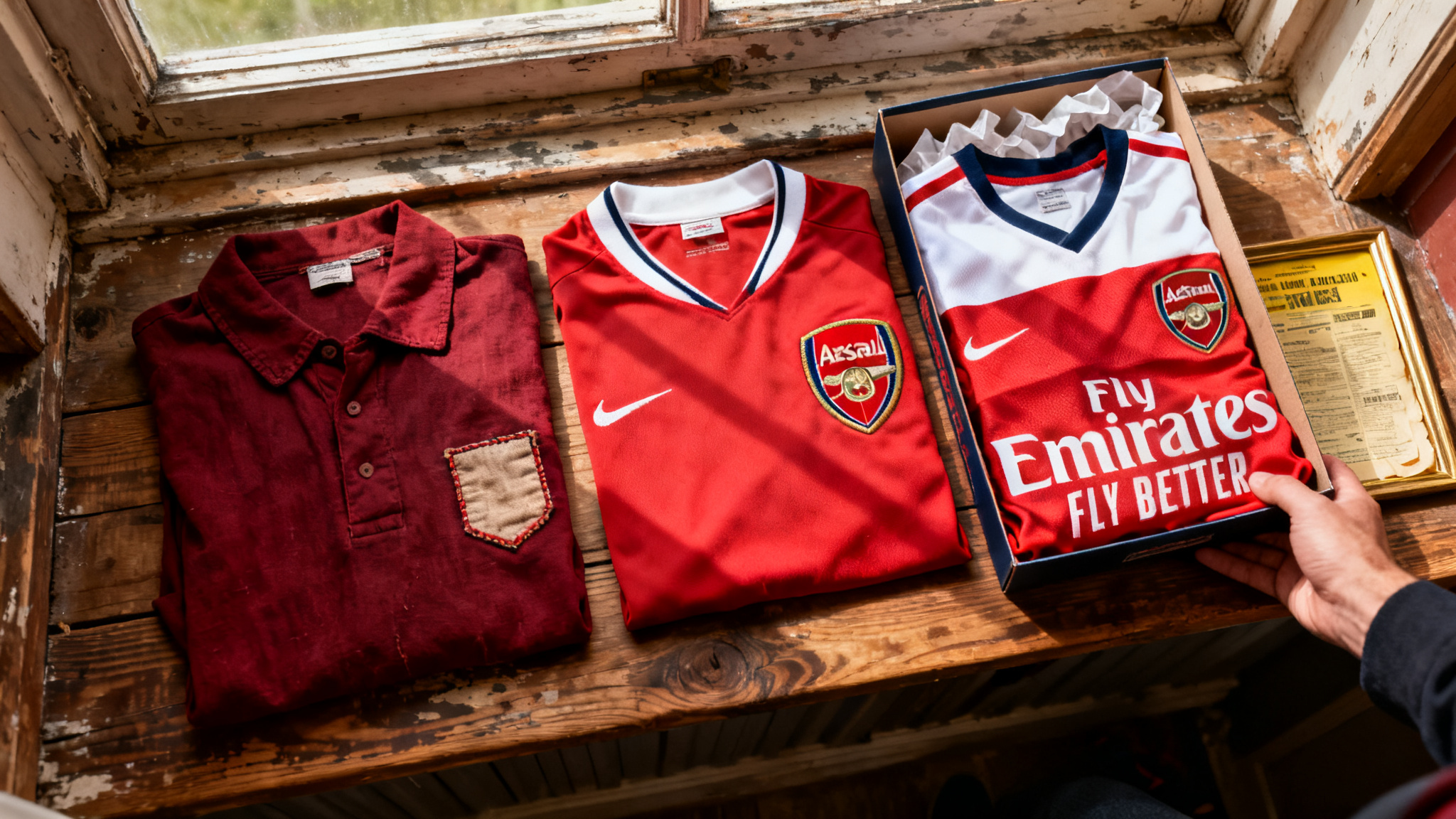
Arsenal’s red shirts trace back to a gift from Nottingham Forest in 1886, when the newly formed Dial Square FC had no funds for proper equipment and gratefully accepted a donated strip from the Midlands club, inheriting a color that would define the Gunners for the next 140 years.
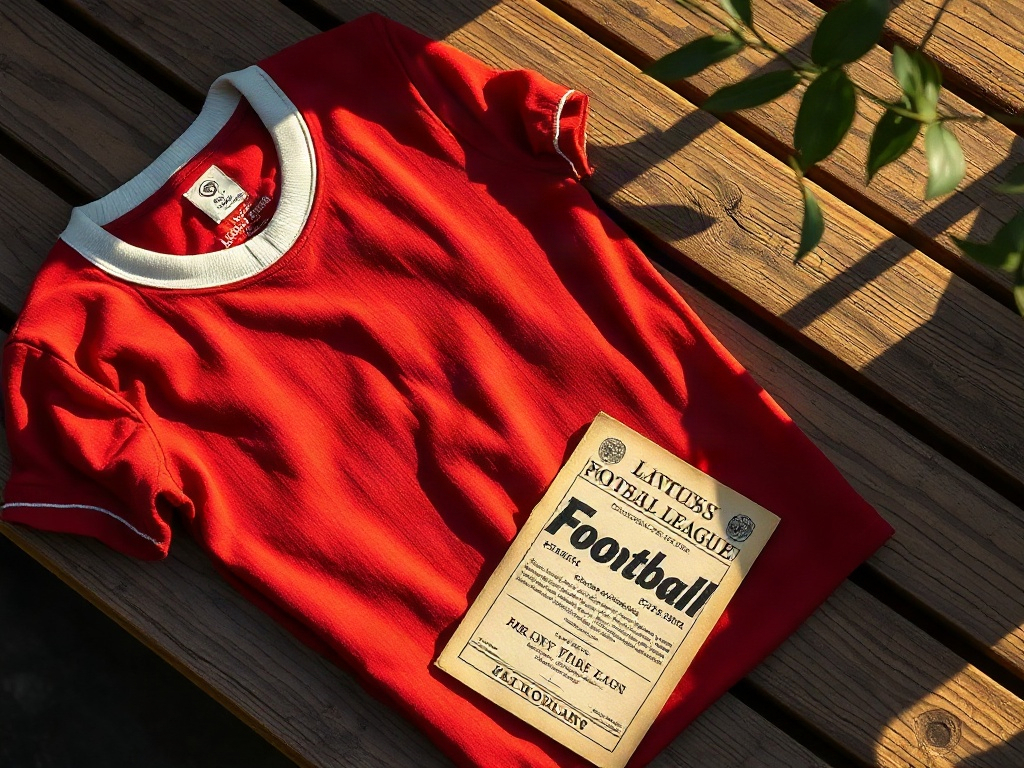
Arsenal began in 1886 as Dial Square FC, formed by munitions workers at the Royal Arsenal in Woolwich. Early kits were workmanlike and practical, sourced wherever they could be found. The first strip was reportedly scarlet red, donated by Nottingham Forest players when the new club had no funds for proper equipment. That detail matters: Arsenal’s red was not chosen by a design committee. It was inherited, almost by accident, from a club on the other side of England. This origin is documented in club historian Gerry Boon’s archival research and corroborated in the official Arsenal history compiled by Phil Soar and Martin Tyler, first published in 1986.
Those original shirts were heavy cotton, collarless at first and later featuring the high button-up collar common to the era. No badge. No sponsor. Just the color and the cut. The club went through several name changes (Royal Arsenal, Woolwich Arsenal) before settling into what it would become, and the kits evolved just as pragmatically.
By 1904, playing in the Football League, the club wore red shirts with white sleeves starting to appear as a variation. But the definitive visual identity was still years away. What these early shirts represent for collectors is rarity in the purest sense: genuine pre-war football shirts survive in very small numbers, and authentic Woolwich Arsenal examples are museum-grade pieces.
Herbert Chapman and the White Sleeves: How the Classic Look Was Fixed (1925-1934)
Herbert Chapman, the manager who arrived at Arsenal in 1925, fixed the red body and white sleeve combination that became the club’s permanent visual identity, a design so well considered that it survived largely unchanged for more than six decades of kit manufacturing.
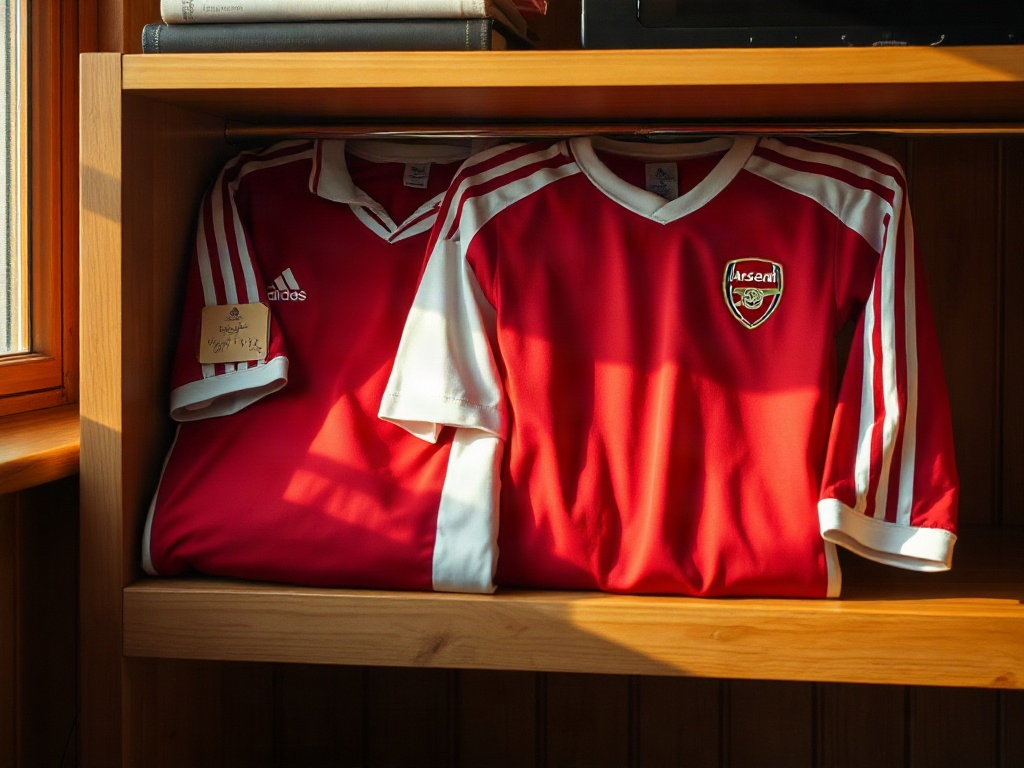
If one name defines Arsenal’s visual identity, it is Herbert Chapman. The manager who arrived in 1925 is rightly credited with tactical innovation, but his influence on the club’s aesthetic runs just as deep.
Chapman introduced the distinctive red-and-white design with white sleeves that became Arsenal’s signature. The exact origin story has two versions. One credits Chapman directly: according to Jonathan Wilson’s Inverting the Pyramid, a widely cited tactical history of football published in 2008, Chapman wanted the team to be identifiable from the stands and from the press box. The other version credits Charlie Buchan, his star forward, who had worn a red-and-white hooped shirt at Sunderland and suggested a variation. Either way, the result was the same: a red body, white sleeves, and a white collar that separated Arsenal visually from every other club wearing red.
By the early 1930s, this look was fixed. The kits of the 1930 FA Cup-winning side and the first league title sides of the early 1930s wore variations of this template. These were plain, unbranded, badge-free garments by today’s standards. The badge, a simple cannon motif, arrived later. But the color architecture Chapman established remained largely untouched for more than 60 years, which tells you everything about how right it was.
Red and white together work visually because high contrast at distance is exactly what the human eye resolves first. The Chapman-era shirts exploited that contrast instinctively, and it is the same reason Arsenal’s colors remain among the most legible on a crowded terrace or a broadcast frame. Colour theorists who study sports identity, including those cited in the Journal of Sport Management‘s 2019 review of kit design heritage, note that clubs with a fixed two-tone home palette from their founding decades build the deepest fan colour associations.
Post-War Kits and the Long Reign of Simplicity (1945-1981)
For most of the post-war period, Arsenal’s home shirt changed very little: red body, white sleeves, white collar, season after season, with the main evolution coming in fabric technology as synthetic fibres began replacing heavy cotton from the late 1960s onward.
For most of the post-war period, Arsenal’s home shirt changed very little in concept. Red body, white sleeves, white collar. The execution shifted with manufacturing: lighter synthetics started appearing in the late 1960s and early 1970s, replacing the thick cotton that had characterized the earlier decades. The weave thinned out. The shirts became easier to wash, easier to produce, and easier to move in.
The first shirt sponsor appeared in 1981 with JVC, making Arsenal one of the earlier First Division clubs to carry advertising on the chest. The club’s commercial relationship with the Japanese electronics brand is documented in the Arsenal Official Illustrated History (Hamlyn, various editions) as a landmark moment in English kit commercialisation. This is a key marker for shirt historians: the pre-JVC Arsenal shirts represent a purer visual era, while the post-1981 shirts document how commercial forces began reshaping kit design across all of English football.
Away kits from this period are particularly interesting. The yellow-and-blue away shirt introduced in 1969 became one of Arsenal’s most beloved alternates. That specific combination, bright yellow with blue trim, ran through several iterations in the 1970s and early 1980s and has been revived multiple times since, always generating strong response from supporters who grew up watching the Gunners on grainy television footage in those colors.
The Adidas Era and the Double-Winning Kits (1986-1994)
Adidas took over kit supply in 1986 and produced shirts across the late 1980s and early 1990s that now carry genuine collector weight, particularly the 1988-89 home shirt worn by Michael Thomas when he scored the title-winning goal at Anfield in the final seconds of the season.
Adidas took over kit supply in 1986, and the shirts they produced across the late 1980s and early 1990s carry real collector weight now. The 1988-89 home shirt, worn in the season Arsenal won the league title at Anfield with Michael Thomas’s last-minute goal, is among the most sought-after Gunners kits on the secondary market. The full account of that night is captured in Nick Hornby’s Fever Pitch, published in 1992, which brought the emotional texture of following Arsenal to a global readership and cemented that shirt’s cultural status.
The construction during this period leaned into the synthetic revolution fully. Lightweight polyester mesh replaced heavier fabrics. The Adidas three-stripe detail ran down the sleeves in white. The shirts felt deliberately modern for the time, a contrast to the chunky cotton weight of the previous decades.
The 1990-91 title-winning shirt followed a similar template. Then came the 1993 cup double kits, which introduced a slightly different cut and the now-iconic thin pinstripe shadow pattern on the red body. These are the shirts worn by Tony Adams, Ian Wright, and a squad that defined Arsenal’s pre-Wenger identity. Finding authentic player-issue versions (cut slightly wider, with printed names and numbers rather than applied vinyl) requires patience and knowledge, but they exist.
The Nike Years and the Invincibles’ Kit (1994-2017)
Nike’s 23-year relationship with Arsenal from 1994 produced the most commercially successful and historically significant run of shirts in the club’s modern era, culminating in the 2003-04 Invincibles home kit that remains the single most sought-after Arsenal shirt on the collector market today.
Nike took over in 1994, beginning a 23-year relationship that produced some of the most commercially successful and visually diverse Arsenal shirts ever made. The shift was immediate and striking: Nike brought American sportswear aesthetics into an English shirt tradition, with bolder graphic treatments and more aggressive collar designs.
The late 1990s produced several polarizing kits. The navy blue away shirt of 1997-98 (the double-winning season under Arsene Wenger) is now seen as a classic, but it felt risky at the time. Navy was not Arsenal’s color. It worked because the construction was clean, the badge placement was right, and the team wearing it was one of the best in England.
The 2003-04 Arsenal Invincibles home kit is the single most historically loaded shirt in the club’s modern era. The team that went the entire Premier League season unbeaten wore a relatively understated red shirt with a white collar and a thin white sleeve trim. Nothing about the design screams genius. But its association with 49 unbeaten league matches has made it the reference point for Arsenal collector shirts, with authentic match-worn versions from that campaign reaching four-figure prices at specialist auctions. The achievement itself is documented exhaustively in Amy Lawrence’s Invincible: Inside Arsenal’s Unbeaten 2003-04 Season (Viking, 2014), which remains the definitive account of what the players wore and how the season unfolded.
Nike’s final Arsenal kits before PUMA took over in 2014 included the celebrated 2005-06 home shirt, worn in the Champions League final in Paris. The cut was slim, the badge large, and the fabrication was among the lightest Nike produced for the club. That shirt tells a story of a team that went further than expected and came just short.
PUMA, Adidas Again, and the Modern Collector Era (2014-2026)
PUMA supplied Arsenal from 2014 to 2019 with shirts that divided opinion at the time but now represent an undervalued window in the collector market, followed by Adidas’s return in 2019 which brought the three-stripe sleeve detail back and sold out on its first release across multiple restocks.
PUMA supplied Arsenal from 2014 to 2019, a period marked by designs that divided opinion sharply. The 2014-15 home shirt introduced a darker red, closer to burgundy than the traditional scarlet. Supporters reacted badly, and PUMA softened the shade in subsequent seasons. The away and third kits from this period were more experimental: a black-and-pink combination from 2015-16 and a yellow-and-navy from 2016-17 that drew directly on the 1969-era yellow away tradition.
Adidas returned in 2019, and the reunion was commercially and aesthetically significant. The first new Adidas home kit reintroduced the three-stripe sleeves explicitly, giving the shirt an intentional vintage reference while using modern Climacool fabrication. It sold out across multiple restocks in the first week, which reflects how strongly supporters responded to the visual callback.
The Adidas 2022-23 away shirt, a muted chalk-white with subtle print detailing, became a particular favorite among design-conscious supporters and jersey collectors internationally. It sold in markets well beyond Arsenal’s traditional fanbase, which shows how global the appetite for quality football shirts has become.
By 2026, Arsenal kits occupy a specific place in the collector market: the Invincibles-era and early-Wenger Nike shirts are genuinely expensive on the secondary market, the late-1980s Adidas pieces are rarer but findable, and the PUMA era is undervalued relative to what it will likely fetch in ten years when nostalgia catches up with it.
If you want to build a serious collection, the PUMA years are the current value window. The fabric quality was solid, the designs were divisive enough to keep prices low now, and they document a transitional period in the club’s history that matters.
Decade by Decade: How the Fabric Changed
The single most reliable way to date an Arsenal shirt is to feel its fabric: each manufacturing era used specific textile technology that cannot be convincingly faked in retrospect, and understanding those differences turns any collector into a confident authenticator.
Every era of Arsenal kit history has its own material fingerprint. A brief comparison shows how dramatically the physical shirts changed even when the visual template stayed constant:
| Era | Typical Fabric | Weight & Feel | Collector Note |
|---|---|---|---|
| 1886-1950s | Heavy woven cotton | Dense, opaque, stiff when dry | Museum-grade rarity; authenticate via weave density |
| 1960s-1970s | Early nylon / polyester blends | Lighter, slight sheen, drapes differently | Sheen impossible to replicate in modern reproductions |
| 1986-1994 (Adidas) | Polyester mesh panels | Breathable, structured, visible texture | Check label font; mesh pattern differs by season |
| 1994-2014 (Nike) | Dri-FIT polyester | Featherlight, no texture, fast-drying | Invincibles shirt: distinctive hand-feel, slim cut |
| 2014-2019 (PUMA) | dryCELL performance polyester | Mid-weight, structured collar, visible rib detail | Undervalued era; solid build quality |
| 2019-present (Adidas) | Climacool recycled polyester | Soft, matte finish, stretch panels | Modern player-issue uses Aeroready upgrade fabric |
Each row in that table is a different conversation you can have with a shirt in your hands. The 1970s sheen is the most immediately obvious tell: no modern polyester reproduces it, which makes genuine pieces from that decade immediately identifiable even without checking the label.
Frequently Asked Questions about Arsenal Jersey History
When did Arsenal start wearing red and white?
The red-and-white combination with the distinctive white sleeves was established in the late 1920s, most commonly credited to manager Herbert Chapman around 1925-1930. The club wore red before that, but the specific architecture of red body and white sleeves became fixed under Chapman and remained the visual standard for decades.
What is the most valuable Arsenal shirt for collectors?
Match-worn shirts from the 2003-04 Invincibles season hold the highest prices in authenticated sales. Player-issue (not retail) versions of the 1988-89 title-winning Adidas shirt also command serious money. Pre-war Woolwich Arsenal shirts, when they surface, are museum-level pieces and rarely reach open auctions.
Which kit manufacturers have supplied Arsenal?
Arsenal’s major kit suppliers have been Umbro (various early periods), Adidas (1986-1994), Nike (1994-2014), PUMA (2014-2019), and Adidas again from 2019 to the present. Before branded sportswear partnerships, shirts were produced by local manufacturers without prominent branding.
Why did Arsenal change the cannon direction on the badge?
The cannon’s direction changed several times across the club’s history, reflecting different crest redesigns. The current forward-facing cannon was part of a full badge redesign in 2002. Collectors use cannon direction as an era identification tool when dating vintage shirts, particularly pre-2002 examples where the rightward-pointing cannon is expected on authentic pieces.
Are replica Arsenal kits from the 1990s worth buying now?
Retail replicas from the 1990s are widely available and reasonably affordable compared to player-issue versions. Their value as collector pieces comes from condition: unworn or lightly worn examples with intact labels and no fading hold their price better than worn-out replicas. The 1988-89 and 1993-94 replica shirts in good condition are currently underpriced relative to their historical significance.
What makes the PUMA Arsenal era worth collecting?
The PUMA years (2014-2019) are currently the most accessible entry point in the Arsenal collector market. Prices remain low because the designs were divisive at the time, but the dryCELL fabric quality was genuinely solid and the era documents a specific chapter in the club’s recent history. In ten to fifteen years, nostalgia will close the price gap with the Nike era.
What the Fabric Always Tells You
Every Arsenal shirt, from the borrowed scarlet cotton of 1886 to the recycled-polyester Adidas releases of the 2020s, carries its era in its material: the fabric weight, weave, and finish are a more honest record of football history than any press release or redesign announcement.
One thing I keep coming back to with Arsenal shirts across all eras: the fabric never lies about what period it is from. The heavy cotton of the pre-war pieces has a particular drape and opacity. The 1970s synthetics have a sheen that no modern reproduction quite captures. The Nike Dri-FIT from 2003-04 has that specific lightweight feel that took sportswear years to perfect.
You can read Arsenal’s entire history through the textile choices across 140 years. From borrowed scarlet shirts in Woolwich to a global brand selling out kits in Tokyo and Lagos, the Gunners’ visual story is one of the most continuous and recognizable in world football. The white sleeves are still there. Chapman would recognize the shirt.
That continuity is rare. It is worth understanding, worth collecting, and worth wearing. ⚽
The shop
Find your jersey
Every Arsenal jersey, with your name and number on the back if you like.
- Free shipping from $65
- 3 jerseys = 1 free
- 14-day returns