SPECIAL OFFER BUY 3 JERSEYS = GET 1 FREE

Match-worn vs match-prepared jerseys: what’s the difference for soccer?
Maillot porté or maillot préparé: two formats of authentic soccer jerseys that many people confuse. This article details the real differences, the authenticity criteria, the average prices in 2026, and how to choose based on your goal as a collector or enthusiast.
In this article8 sections
- Two Soccer Jerseys That Look Alike but Aren’t Equal
- Match-worn jersey: the exact definition, no shortcuts
- Match-prepared jersey: intended for the game, left on the bench
- Comparison table: game-worn vs player-issue at a glance
- How clubs manage their jersey sales in 2026
- Concept football jerseys: a third category to know
- FAQ: match-worn vs match-issued jerseys
- Choosing between match-worn and match-prepared based on your real goal
Two Soccer Jerseys That Look Alike but Aren’t Equal
You’re holding two seemingly identical soccer jerseys in your hands. Same crest, same lettering, same colors. Yet one is worth three times as much as the other. The difference comes down to a single word: match-worn jersey. Understanding the distinction between match-worn vs. match-prepared jerseys is essential for any enthusiast who wants to buy at the right price, sell without getting duped, and build a collection that has real meaning.
In 2026, the market for authentic soccer jerseys has never been more active. Major sports auction houses are hitting record numbers, professional clubs are expanding official jersey sale programs, and savvy fans know exactly what they’re looking for. Still, you need to master the vocabulary, the visual markers, and the classic pitfalls of this niche market.
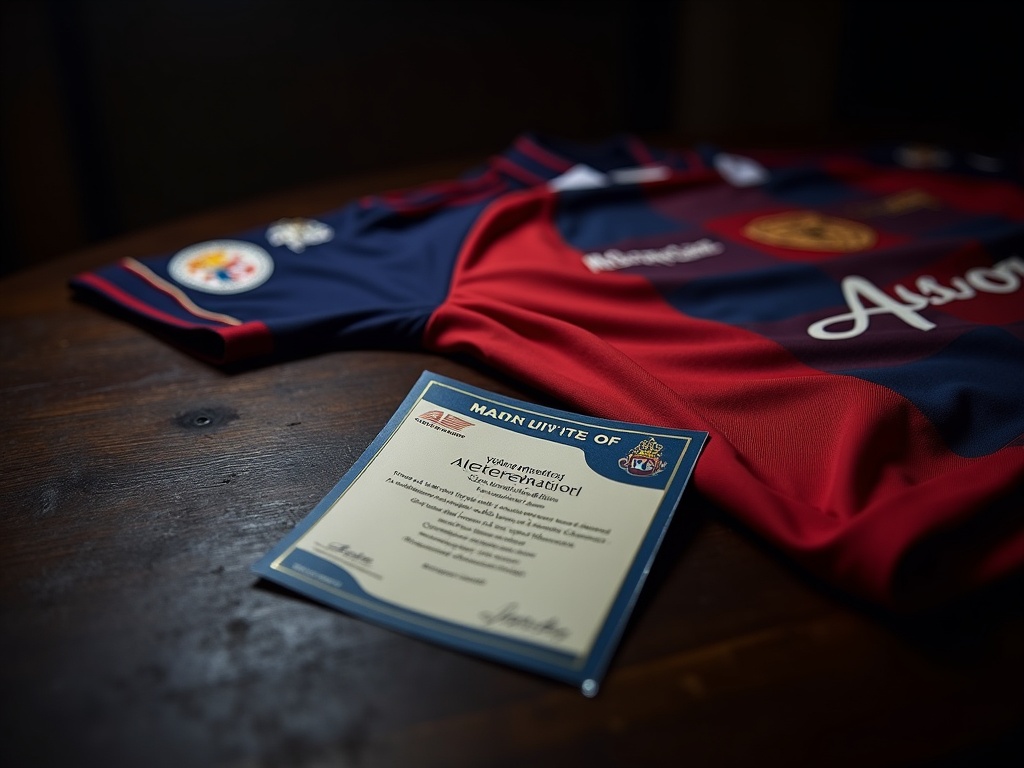
Match-worn jersey: the exact definition, no shortcuts
A match-worn jersey is one a player actually put on during an official match: league game, national cup, European competition, or international fixture. It bears the physical marks of the game: sweat, snags, slight distortions in the stitching, sometimes grass or mud stains.
These signs of wear are not defects. For a serious collector, they are concrete proof of presence. A match-worn jersey with no signs of game use immediately raises suspicion, and for good reason: counterfeits in this segment are frequent and sophisticated.
What certifies a jersey was truly worn in a match
- A Certificate of Authenticity (COA) issued by the club, a recognized auction house, or an independent certification body (e.g., Beckett Authentication Services, PSA, or the club’s internal services).
- Press photos or video footage showing the player wearing that exact jersey number during the match in question.
- The presence of serial numbers or internal markings sewn in by the club before each game.
- Consistent physical characteristics: a size suited to the player’s build (often slim-cut XXL for midfielders, loose XL for center-backs).
- Localized and consistent wear marks related to the player’s position (shoulder snags for a goalkeeper, knee distortion for a box-to-box midfielder).
Match-prepared jersey: intended for the game, left on the bench
A match-prepared jersey is one that went through the entire official equipment process: lettering with the player’s name and number, custom sizing based on their measurements, integration of competition patches (league, cup, fair play). It came out of the same locker room as a match-worn jersey, prepared with the same care, delivered at the same time.
The key difference: this jersey never touched the grass. Sometimes swapped at the last minute for another color, sometimes prepared for a game that was ultimately postponed, sometimes kept as a backup, it remains new or like-new. This freshness is both its strength (perfect condition, preserved value) and its limit (absence of the emotion of the game actually played).
Why the match-prepared jersey still has value
A match-prepared jersey is not a replica jersey sold in stores. It’s manufactured to professional specifications: Vaporknit, AeroSwift, Heat.RDY, or equivalent fabric depending on the brand, custom athletic cut, reinforced seams, sublimation-printed or heat-pressed back name/number per club standards. You’re not buying a mass-market product: you’re buying an object designed for a professional, produced in very small quantities.
For collectors with a mid-range budget, the match-prepared jersey often represents the best compromise: guaranteed authenticity, perfect condition, more accessible price. It’s also the ideal format for clean framing, without worrying about losing wear marks that moisture or time might have altered.
To go further on the manufacturing criteria that set apart a pro jersey from a retail replica, check out our guide on authentic vs replica soccer jerseys.
Comparison table: game-worn vs player-issue at a glance
| Criteria | Game-Worn Jersey | Player-Issue Jersey |
|---|---|---|
| Used in an official match | Yes | No |
| Pro specs (cut, fabric) | Yes | Yes |
| Physical condition | Match wear (sign of authenticity) | New or like new |
| Average market value | $340 to several thousand $ | $91 to $456 |
| COA (Certificate of Authenticity) | Essential | Recommended |
| Resale interest | Very high | Moderate to high |
| General public access | Rare (auctions, specialty shops) | More common |
How clubs manage their jersey sales in 2026
Over the past three to four years, professional clubs have structured their approach. Some sell directly through their official online store (“authentic” or “player issue” section), while others go through authorized partners. Specialized platforms like Classic Football Shirts, Catawiki, or auction houses like Christie’s Sports have professionalized the segment, with increasingly rigorous certification processes.
Clubs in the Premier League and La Liga are the most active in this market. Several Ligue 1 teams have launched similar programs over the past two seasons, with very encouraging results in terms of demand. The underlying trend: fewer jerseys swapped in the locker room after the final whistle, and more pieces directed toward traceable sales channels.
The role of the match number and internal markings
Many clubs sew a match number or internal code inside the jersey before each game. This marking allows the buyer to link the jersey to a date, an opponent, a score. For historic matches (cup finals, derbies, club centennials), this detail skyrockets the value. It’s this concrete narrative link that transforms fabric into a collectible.
A jersey worn during a regular matchday 20 league game doesn’t sell for the same price as one worn in a European final. The historical context of the match matters just as much as the player’s identity. It’s the combination of both that determines the real value on the secondary market.
Concept football jerseys: a third category to know
Alongside match-worn and match-issued, a third category is gaining traction: the exclusive concept jersey. These aren’t pieces from pro locker rooms, but original creations designed for football culture enthusiasts: unique colors, custom typography, numbered editions. The logic is different, and that’s precisely what makes them interesting.
These creations occupy a distinct space: they don’t claim match authenticity—they boast creativity and exclusivity. If you’re looking for something to wear in the stands or display on a wall with style, our limited edition concept jerseys serve that purpose far better than a brand-new match-issued jersey you’d be afraid to damage in value. To understand where each format sits in the market hierarchy, also check out our guide on how to spot a player-issue jersey.
For those wanting to understand the manufacturing differences between pro authentic jerseys and standard retail replicas, our article on authentic vs replica football jerseys breaks down the entire process cut by cut.
FAQ: match-worn vs match-issued jerseys
Everything you’re wondering before buying or selling (click to expand).
Can a match-issued jersey become match-worn after the fact?
No. The distinction is set at the time of the match. If the jersey never left the locker room to touch the pitch during an official game, it remains “match-issued.” Some unscrupulous sellers try to blur the line: be wary if a COA for a “match-worn” jersey doesn’t explicitly list the date and match. A good COA always states the competition, opponent, and score.
How do I verify the authenticity of a match-worn jersey bought online?
Three steps: first, demand the original COA referencing the match (date, competition, opponent). Second, cross-reference with photo or video archives from the game (Getty Images, club archives). Third, if the price is high, use a reputable third-party authentication service (Beckett, PSA, or equivalent). A serious seller will never refuse these checks.
Does a match-issued jersey with a standard number (e.g., #10) have less value than one with a player name?
Generally, yes. A jersey with a player name and number is more traceable and thus more valuable. A jersey with just a number and no name loses some traceability, unless the match context or a solid COA compensates for it.
Is it profitable to invest in authentic football jerseys in 2026?
The market shows a positive ten-year trend, but it’s not a risk-free investment. Jerseys of iconic players from historic matches appreciate well. However, jerseys of players whose careers stall or end abruptly can lose value. First, buy what you love: sentimental value is the only zero-risk guarantee. Our 2026 jersey site comparison can help identify reliable sellers.
What’s the price difference between a match-worn and match-issued jersey of the same player?
The ratio varies a lot depending on the player, match, and sale timing. Generally, a match-worn vs match-issued jersey of the same player from the same season shows a 2 to 5 times gap. For current icons (Mbappé, Bellingham, Vinicius Jr), the gap can exceed that ratio on European competition matches.
What price should you expect for a match-worn or match-prepared jersey by 2026?
For a mid-table Ligue 1 player, a match-prepared jersey typically ranges from $91 to $171. A match-worn jersey from the same player starts around $228 to $399 depending on the match. For Premier League or La Liga stars, the ranges go up to $342-$684 (prepared) and $912 to several thousand dollars (worn in a key match). The 2026 trend is upward: online auctions have expanded the international buyer base, driving prices higher for certified pieces.
Choosing between match-worn and match-prepared based on your real goal
If you’re building a heritage collection with an investment angle, the certified match-worn jersey is your playground. Every detail matters: the match, the player, the certification, the condition. Keep it framed, in an anti-UV case, away from humidity and temperature swings. A poorly preserved match-worn jersey loses value just as surely as a missing COA.
If you want to own an authentic professional item, close to the player but affordable, the match-prepared jersey makes sense. You get professional-grade manufacturing quality, official customization, and a price that doesn’t require diving into auctions. It’s also the ideal entry point for a beginner collector looking to learn how to read the market before investing more.
And if you’re primarily looking to express your soccer passion with a unique item hard to find elsewhere, our exclusive soccer jersey editions offer a creative alternative, without claiming to match the traceability of a professional locker room. It’s a different type of collection, just as legitimate.
For fans of iconic clubs with historic customizations, our vintage soccer jersey collection brings together the most sought-after pieces, with provenance details clearly outlined on each product page. Whatever your entry point into the world of match-worn vs. match-prepared jerseys, the key is knowing what you’re buying and why.
The shop
Find your jersey
Clubs, national teams, concept and retro designs. With your name and number, if you like.
- Free shipping from $65
- 3 jerseys = 1 free
- 14-day returns