SPECIAL OFFER BUY 3 JERSEYS = GET 1 FREE

7 Signs That Tell You If a Football Jersey Is Real
Seven practical checks that tell you whether a football jersey is genuine or counterfeit: reading label systems and barcodes, testing holographic security seals, inspecting stitching from the inside, assessing 3D crest embroidery, identifying authentic performance fabric weight, checking name and number flock bonding, and using QR code and NFC digital authentication. Includes a side-by-side look at how fakes differ at each checkpoint, plus answers to the most common questions buyers have about replicas, price signals, and washing effects on authentication features.
In this article11 sections
- Why Knowing the Difference Actually Matters
- How to Tell If a Football Jersey Is Real: The 7-Check Method
- 1. The Label System: More Information Than Most People Read
- 2. The Hologram and Security Seal
- 3. Stitching Quality Under Pressure
- 4. The Printed or Embroidered Crest: 3D, Not Flat
- 5. Fabric Weight and Performance Texture
- 6. Name and Number Flock: Edges, Layers, and Heat Resistance
- 7. The QR Code and Digital Authentication Chain
- FAQ: How to Tell If a Football Jersey Is Real
- Reading the Shirt the Way a Collector Does
Why Knowing the Difference Actually Matters
You’ve found a jersey at a price that feels almost too good. The crest looks right. The colors check out. But something sits at the back of your mind, a small doubt that you can’t quite shake. That instinct is worth trusting.
Counterfeit football jerseys have gotten sharper over the past decade. Sellers photograph them well, pack them in convincing boxes, and list them at prices just close enough to retail to seem credible. The gap between a fake and an authentic football jersey isn’t always visible at a glance anymore. You have to know what to look for, and where.
These seven checks won’t take more than ten minutes. Together, they cover the physical, the digital, and the structural. Run through all of them before you commit to any purchase, whether you’re buying online or holding the shirt in your hands at a market stall. Knowing how to tell if a football jersey is real is one of the most useful skills any serious supporter or collector can develop.
How to Tell If a Football Jersey Is Real: The 7-Check Method
Before we walk through each check in detail, the table below gives you a quick reference for the most common points of difference between a genuine shirt and a counterfeit. Bookmark it, screenshot it, pull it up the next time you’re standing at a market stall or scrolling through a resale listing.
| What to check | Genuine jersey | Counterfeit jersey |
|---|---|---|
| Care label typography | Clean print, consistent font spacing, flat stitching | Blurred ink, size indicator misalignment, puckered label edge |
| Holographic sticker | Shifts color and pattern on tilt, adhesive leaves residue if peeled | Flat, static, printed appearance; no directional shift |
| Interior seams | Reinforced at stress points, even thread tension, fully flat | Rough finish, uneven tension, skipped stitches at underarm |
| Club crest | Layered embroidery, sits proud of fabric, clean thread terminations | Flat transfer or thin embroidery, lifting edges, uniform light reflection |
| Fabric hand | Lightweight engineered polyester, consistent recovery when pulled | Heavier or softer cheap polyester; coarse or absent inner mesh |
| Name/number flock | Heat-bonded, sharp letter edges, flexes with fabric | Adhesive-applied, lifting at corners, cracks after first wash |
| QR code / NFC chip | Routes to official manufacturer verification page on correct domain | No code, dead link, or third-party lookalike domain |
1. The Label System: More Information Than Most People Read
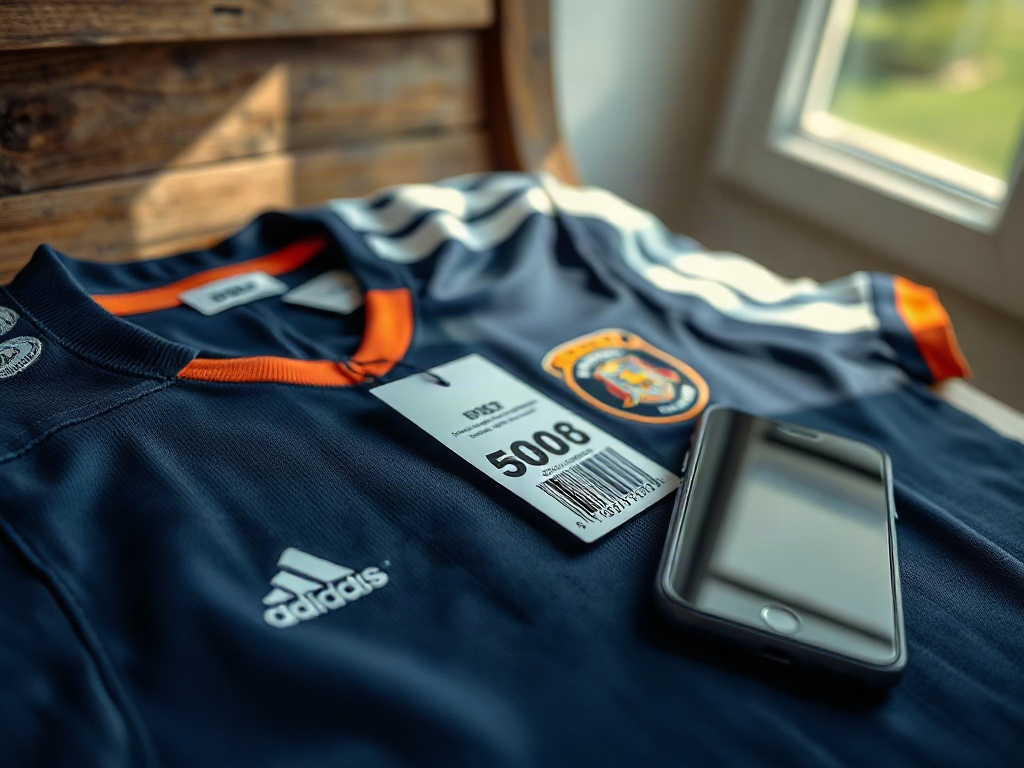
Every licensed football jersey carries a set of labels. The care label sewn into the collar or side seam is the first place to check. On a genuine shirt, the text is printed cleanly with no ink bleeding, the stitching that attaches the label lies flat without puckering, and the font spacing is consistent all the way through.
Counterfeit labels often have slightly wrong fonts, misaligned text, or spacing errors on the size indicators. Hold the label under direct light and look at the print quality on the size number itself. Genuine kits from the major kit manufacturers use tight, precise typography. Blurring or uneven ink saturation is a real red flag.
The barcode printed on the retail tag (if the jersey is still on its original hanger tag) should be scannable. Scan it with a phone. It should resolve to the correct product on the manufacturer’s own retail system. A barcode that returns no result or routes to a generic page is worth questioning.
2. The Hologram and Security Seal
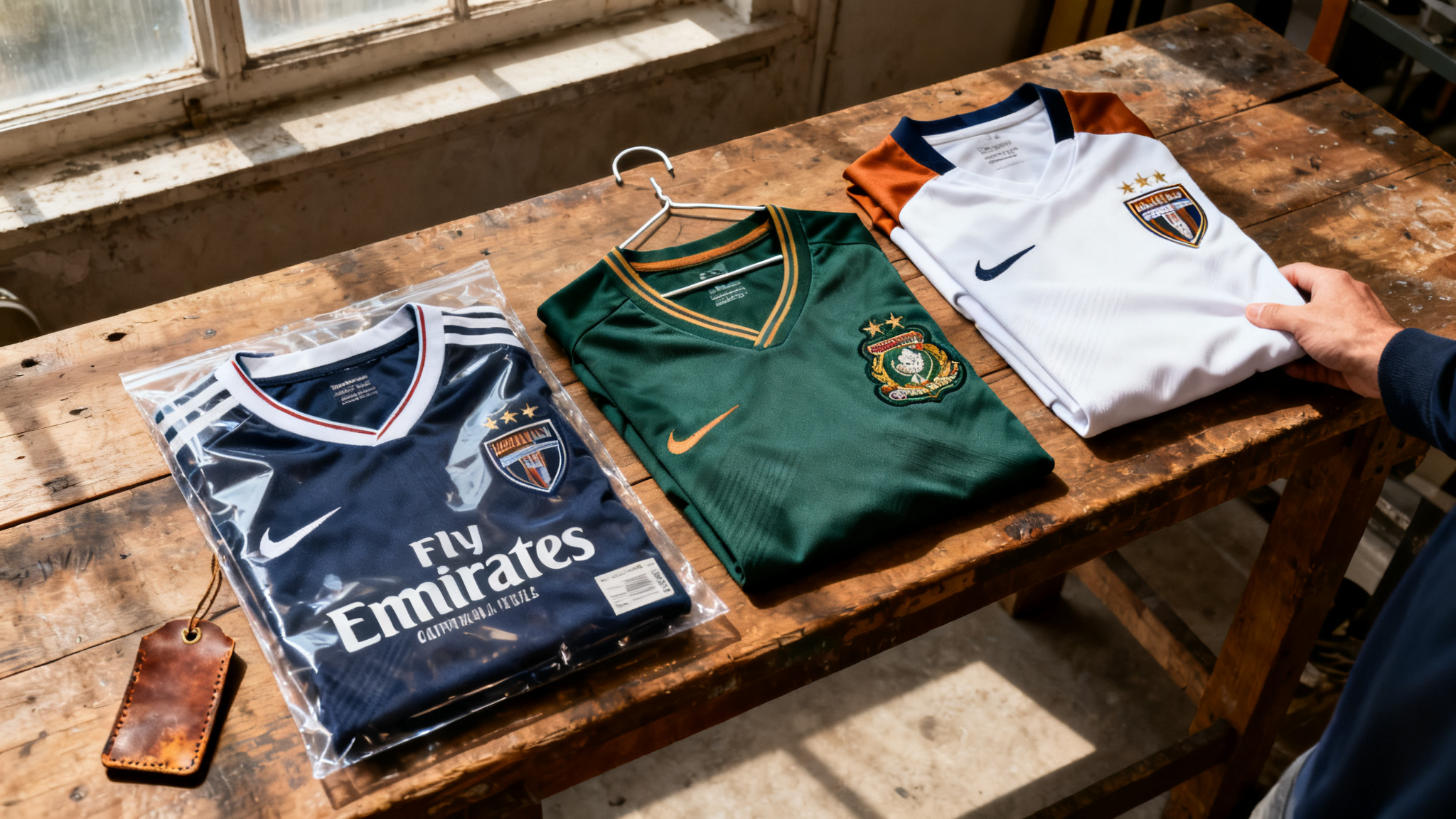
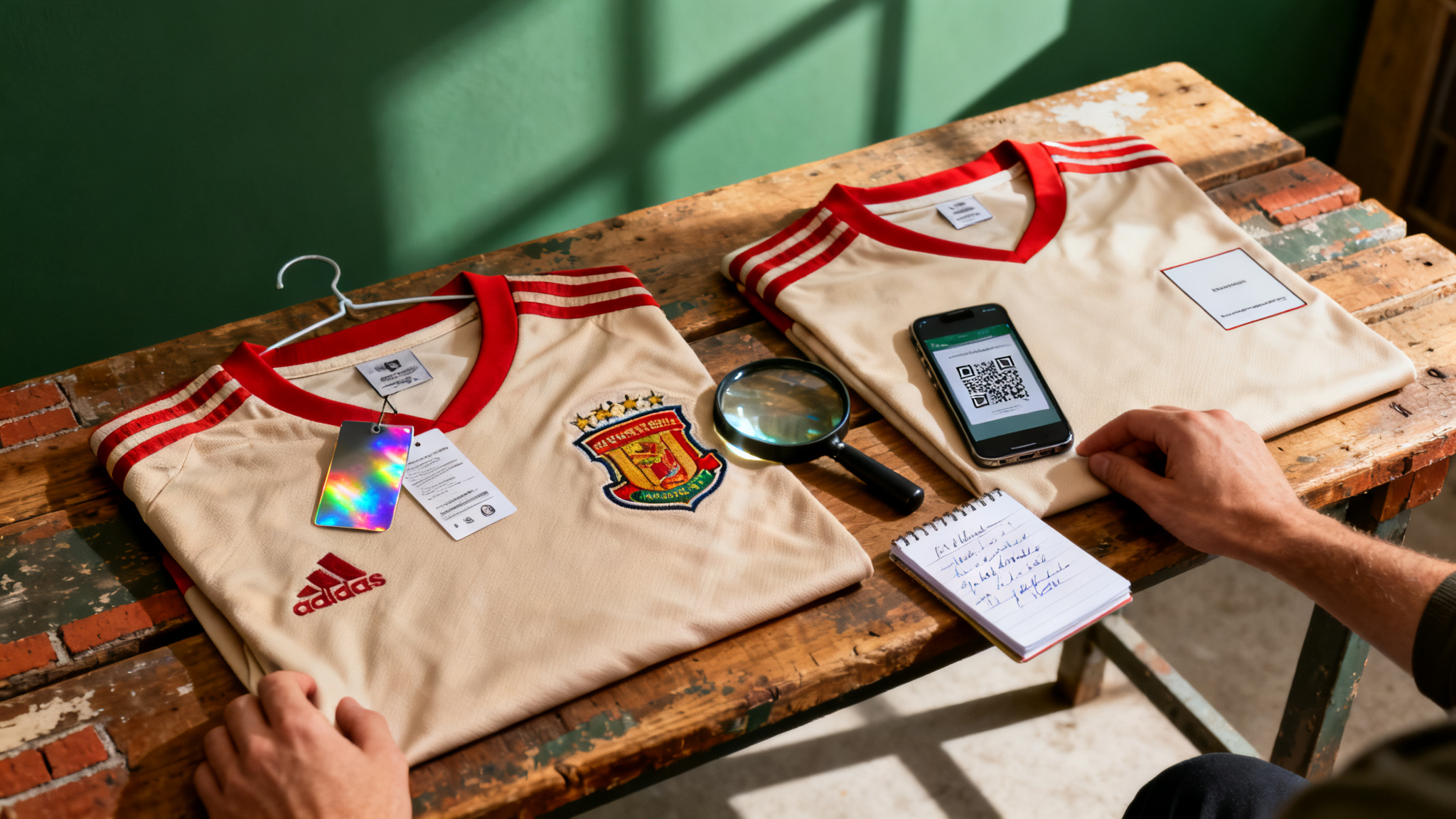
Nike, Adidas, and Puma all use holographic security stickers on their licensed football jerseys. The placement varies by brand, but the function is consistent: the hologram shifts color and pattern when tilted, and the adhesion is designed to leave a visible residue if someone tries to peel and reapply it.
On a fake jersey, the hologram sticker is usually printed flat. Tilt it side to side. A real hologram shows depth, color shift, and a micro-pattern that you cannot replicate with standard printing. A printed fake looks like a photograph of a hologram. Flat, no movement, slightly glossy but static.
Some kits use a sewn-in security patch rather than a sticker. These patches contain fine thread patterns woven at angles that change under UV light. If you’re buying pre-worn or vintage-style jerseys, the absence of this patch alone isn’t damning, but its presence in degraded or visibly fake form is a clear signal.
3. Stitching Quality Under Pressure
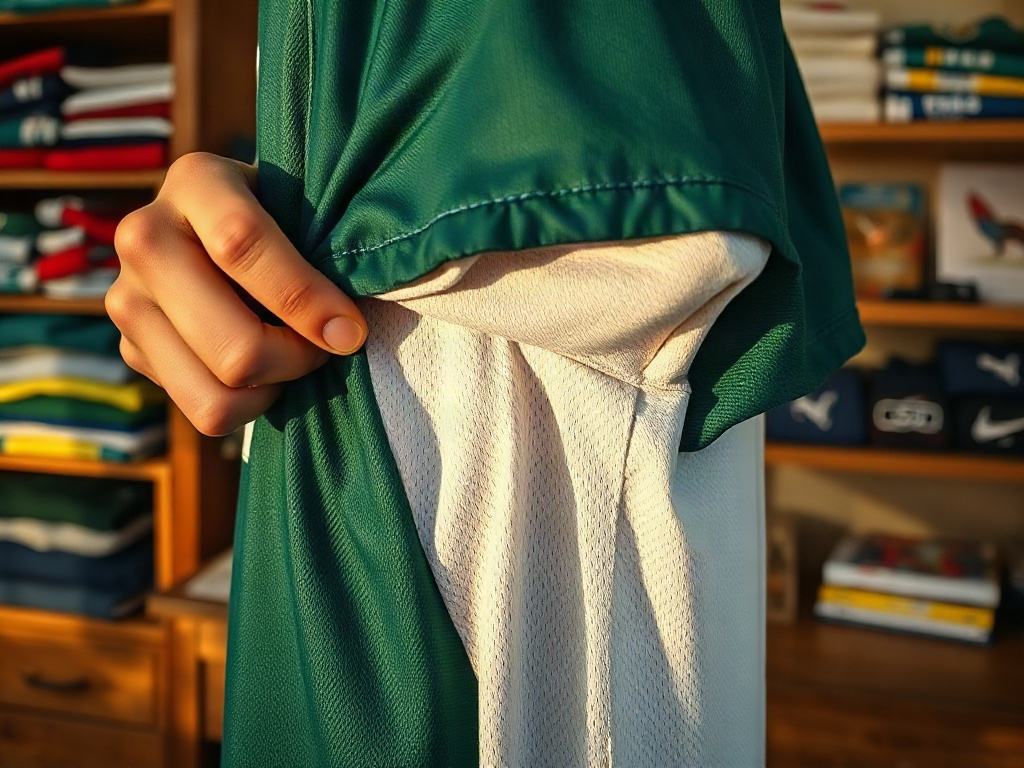
Turn the jersey inside out. This single action reveals more about its origin than almost any other check. Authentic jerseys have reinforced seams at every stress point: the underarm junction, the shoulder join, the side panel seam. The thread count is consistent, the tension even, and there are no loose threads or skipped stitches.
On a counterfeit, the inside of the jersey often looks rougher than the outside. You’ll see uneven tension, pulled threads, or places where the seam allowance is noticeably thinner. The underarm is particularly telling because it’s a structurally demanding part of the shirt that manufacturers reinforce carefully.
Run your thumb along the side seam. On a real shirt, the seam feels smooth and lies completely flat against the fabric. On a fake, you may feel small ridges, catches, or variations in the stitch density. The fabric doesn’t lie, and seams don’t hide what they are.
4. The Printed or Embroidered Crest: 3D, Not Flat
Club crests on authentic football jerseys with official crest embroidery are built up in layers. The badge sits proud of the fabric surface by a fraction of a millimeter, the thread direction changes across different zones of the design, and the edge of the badge is clean with no fraying thread ends visible.
Counterfeit crests take one of two forms: a flat printed transfer that sits on the surface like a sticker, or a low-density embroidery that feels thin under the fingers. Run your thumb slowly across the crest. On a genuine shirt, you feel the layered thread structure, like a small topographic map. On a fake transfer, you feel a flat, slightly rubberized texture with edges that may already be lifting at the corners.
The color accuracy matters too. Compare the crest under natural light against a reference image from the club’s official shop. Genuine embroidery thread absorbs light differently from printed ink. The colors look richer and slightly different depending on the angle. Printed fakes look the same from every direction.
5. Fabric Weight and Performance Texture
Authentic match jerseys from the major kit suppliers are made from engineered polyester fabrics with specific weight and breathability properties. Adidas’ Aeroready, Nike’s Dri-FIT ADV, and Puma’s dryCELL are all proprietary fabric systems. You can feel the difference the moment you pick up a real shirt.
The fabric has a particular hand: lightweight but structured, with a fine mesh texture on the reverse side that sits against skin. Hold it between two fingers and gently pull. Genuine performance fabric has a consistent recovery. It springs back without the slight distortion you get from lower-grade polyester.
Fake jerseys often use a heavier, cheaper polyester that feels either too stiff or too soft. The mesh on the reverse, if it exists at all, is coarser. Some counterfeits are actually cotton-polyester blends, which you can identify by feel and by the fact that they wrinkle more easily. A quick burn test on a loose thread (only if you own the jersey) confirms the fiber: genuine performance polyester melts and beads, cotton chars and smells of burning paper.
6. Name and Number Flock: Edges, Layers, and Heat Resistance
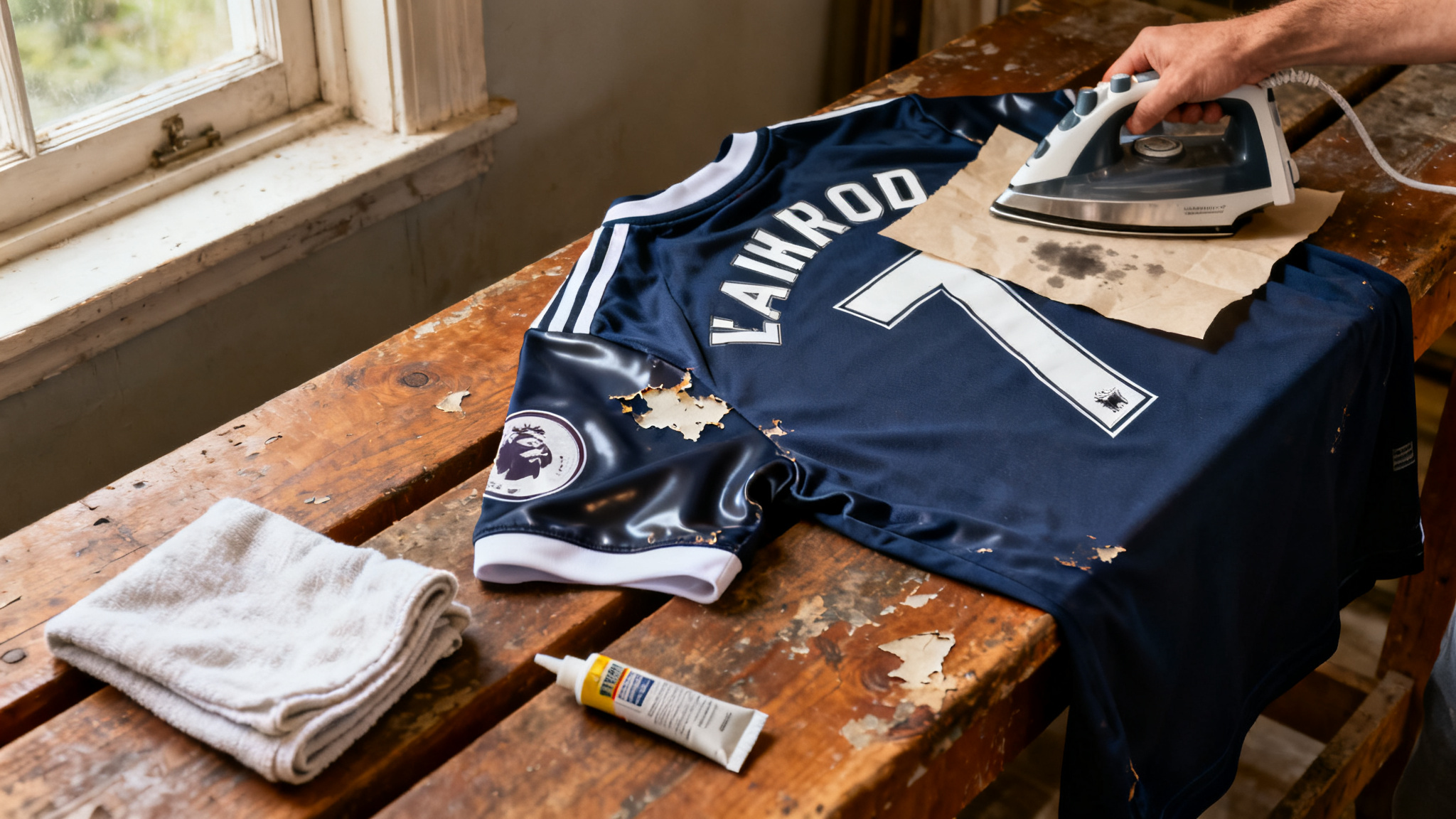
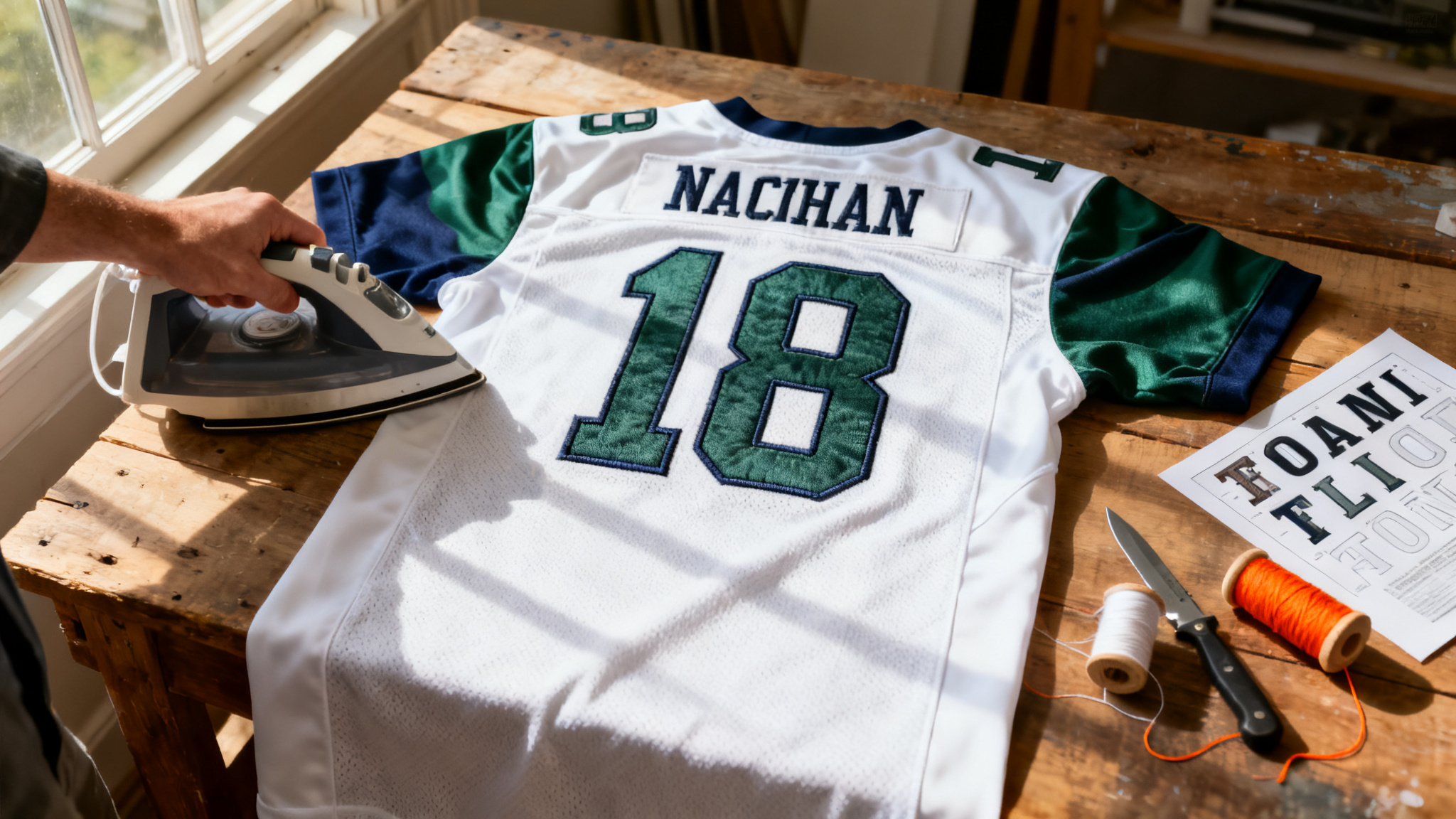
The name and number on a genuine customized jersey are applied through a heat-bonding process that fuses the letters to the fabric at a molecular level. The edges of each letter are sharp, the corners of angular letters like “A” or “V” terminate cleanly, and the surface of the flock has a consistent velvet-like texture across every letter.
Fake flocking uses adhesive rather than heat bonding in most cases. The letters feel slightly raised and separate from the fabric rather than part of it. Press your thumbnail against the edge of a letter and pull sideways gently. On a genuine application, you’ll feel the letter flex with the fabric. On a fake, you’ll feel the edge of the letter as a distinct, potentially lifting boundary.
Check the corners of numbers like “4” or “7” where the angles meet. On genuine flock, these junctions are clean and fully bonded. On counterfeits, these are the first places to show separation, cracking, or peeling, especially if the jersey has been washed even once.
7. The QR Code and Digital Authentication Chain
From 2022 onwards, most major kit manufacturers began embedding digital authentication into their licensed products. This takes the form of a QR code on the care label, a near-field communication (NFC) chip sewn into the collar, or a linked product code that registers to the official club merchandise database.
Scan the QR code on the label with any phone camera. On a genuine jersey, this should route to a product verification page on the manufacturer’s own domain, showing the specific colorway, the licensed club, and the season year. Nike’s Authenticity product pages, for example, show the exact product against a photograph of the shirt.
Counterfeit jerseys either have no QR code, carry a generic code that resolves nowhere, or link to a third-party page designed to mimic the official verification experience. Check the URL carefully. It should be on nike.com, adidas.com, or puma.com, not on a domain that approximates those names with extra characters.
For older jerseys without QR codes, cross-reference the lot number printed on the care label with the season’s documented production codes, which collectors and authentication specialists maintain in dedicated communities online. These communities are a genuinely useful resource for verifying how to authenticate a vintage football shirt from the 1990s and early 2000s. If you’re hunting for a specific retro edition, our guide to retro football jerseys covers what to expect from genuine archive pieces.
FAQ: How to Tell If a Football Jersey Is Real
Can a counterfeit jersey pass all seven checks? ▾
In 2026, the highest-quality counterfeits can pass two or three checks individually. Passing all seven is extremely unlikely. The QR code and NFC digital authentication in particular require access to manufacturer databases that counterfeit operations cannot replicate. Focus on the digital checks first, then verify the physical ones. A jersey that fails any one of the digital authentication steps and also shows a stitching inconsistency should be treated as a fake, regardless of how convincing everything else looks.
Do replica jerseys count as fakes? ▾
No, and this distinction matters. Replica jerseys are officially licensed products sold at a lower price point than match-spec shirts. They’re made with slightly different fabric weight and fewer performance features, but they carry genuine holographic labels, real crests, and authentic barcodes. The line that counts legally and ethically is between a licensed replica (sold with manufacturer and club permission) and a counterfeit (sold without any license, often falsely claimed to be the full match version). If you’re not sure which tier you need, our authenticated jersey collection shows both options side by side.
What’s the safest place to buy an authentic football jersey? ▾
Club official shops, the kit manufacturer’s own online store, and authorized retailers who display their official license documentation are the safest options for new kits. For vintage jerseys, specialist retailers with physical authentication processes and documented provenance are the reliable route. Peer-to-peer resale platforms vary enormously; always ask the seller to run through the label and QR code checks with you before committing.
Is the price a reliable indicator of authenticity? ▾
Price is a useful but imperfect signal. In 2026, a new full match-spec licensed jersey from a Premier League club typically retails between $90 and $140. A price below $45 for a current-season match shirt should trigger all seven checks immediately. That said, some counterfeit operations now price their products close to retail specifically to avoid suspicion. Price is one data point, not a conclusion on its own.
Does washing a jersey affect the authentication features? ▾
QR codes and barcodes on care labels can fade with repeated incorrect washing. Always wash at 30 degrees with the jersey turned inside out to preserve label print quality and hologram adhesion. NFC chips embedded in the collar are generally waterproof and survive normal machine washing. The physical checks, including stitching quality, crest embroidery, and flock application, actually become easier to assess after the first wash: any weaknesses in fake adhesion show up quickly once the shirt has been through a cycle.
How do I know if a football jersey is real when buying online without handling it? ▾
Ask the seller for close-up photos of the care label, the hologram sticker, and the inside of the underarm seam. A genuine seller with a real product will have no hesitation providing these. Check that any QR code shown in photos is scannable from the image itself (some buyers zoom in and try this before purchasing). And verify that the seller is either an authorized retailer or can provide documented provenance. If they’re reluctant to share any of these, that hesitation is informative.
Reading the Shirt the Way a Collector Does
Running these checks takes practice. The first few times, you’ll feel uncertain whether what you’re seeing is a red flag or just normal variation. That uncertainty narrows fast. After ten or fifteen shirts, your hands and eyes calibrate to what genuine fabric, genuine embroidery, and genuine security features actually feel and look like.
The goal isn’t paranoia. Most jerseys sold through reputable channels are exactly what they say they are. The goal is building the confidence to buy from any source, including secondary markets, specialist vintage sellers, and smaller independent retailers, without second-guessing yourself afterwards. That confidence comes from knowing the checks cold, not from trusting any single seller’s word.
If you want to go deeper on what separates a collector-grade authentic shirt from a standard licensed replica, the Premier League’s official licensed product guidance covers the full scope of what licensing actually means for physical goods.
Ready to put these checks to work on a shirt you’ll actually wear? Below are two picks from our verified collection, each one sourced through the same authentication process described in this article.
Verified pick
Authentic Match Jerseys
Full match-spec kits sourced directly from licensed distributors. Every shirt passes label, hologram, seam, and QR checks before it reaches you.
Browse authenticated jerseys
Verified pick
Retro & Vintage Jerseys
Archive editions from the 1990s and 2000s, each verified for provenance and fabric integrity. No transfers, no reprints: only original licensed production runs.
Explore retro kits
The shop
Find your jersey
Clubs, national teams, concept and retro designs. With your name and number, if you like.
- Free shipping from $65
- 3 jerseys = 1 free
- 14-day returns