SPECIAL OFFER BUY 3 JERSEYS = GET 1 FREE

Haaland Jersey Name and Number: What Every Fan Needs to Know Before Buying
Everything fans need to know about the Haaland jersey name and number: the correct spelling, official font, numbering history at Man City, printing vs. embroidery options, and how to avoid the most common customization mistakes.
In this article7 sections
- The Official Details: Spelling, Font, and Number
- Print vs. Embroidery: Which Finish Holds Up
- Sizing the Name and Number for Your Shirt
- Spotting a Fake: What the Lettering Tells You
- Haaland’s Jersey Across City Kits: Home, Away, Third
- Frequently Asked Questions about the Haaland Jersey Name and Number
- Caring for a Customized Jersey So the Lettering Lasts
The jersey is in your hands. You flip it over and something looks off. The letters sit a fraction too low. The font has a slightly wrong weight. The “9” under “HAALAND” is a shade paler than the badge on the front. You can feel it even if you can’t immediately name it. Getting the Haaland jersey name and number right matters more than most fans realize, and the gap between correct and almost-correct is wider than a millimeter of misaligned heat-press.
This is the full picture: the official details, the history behind the number, the printing and embroidery options worth knowing, and the mistakes that are easy to avoid once someone points them out.
The Official Details: Spelling, Font, and Number
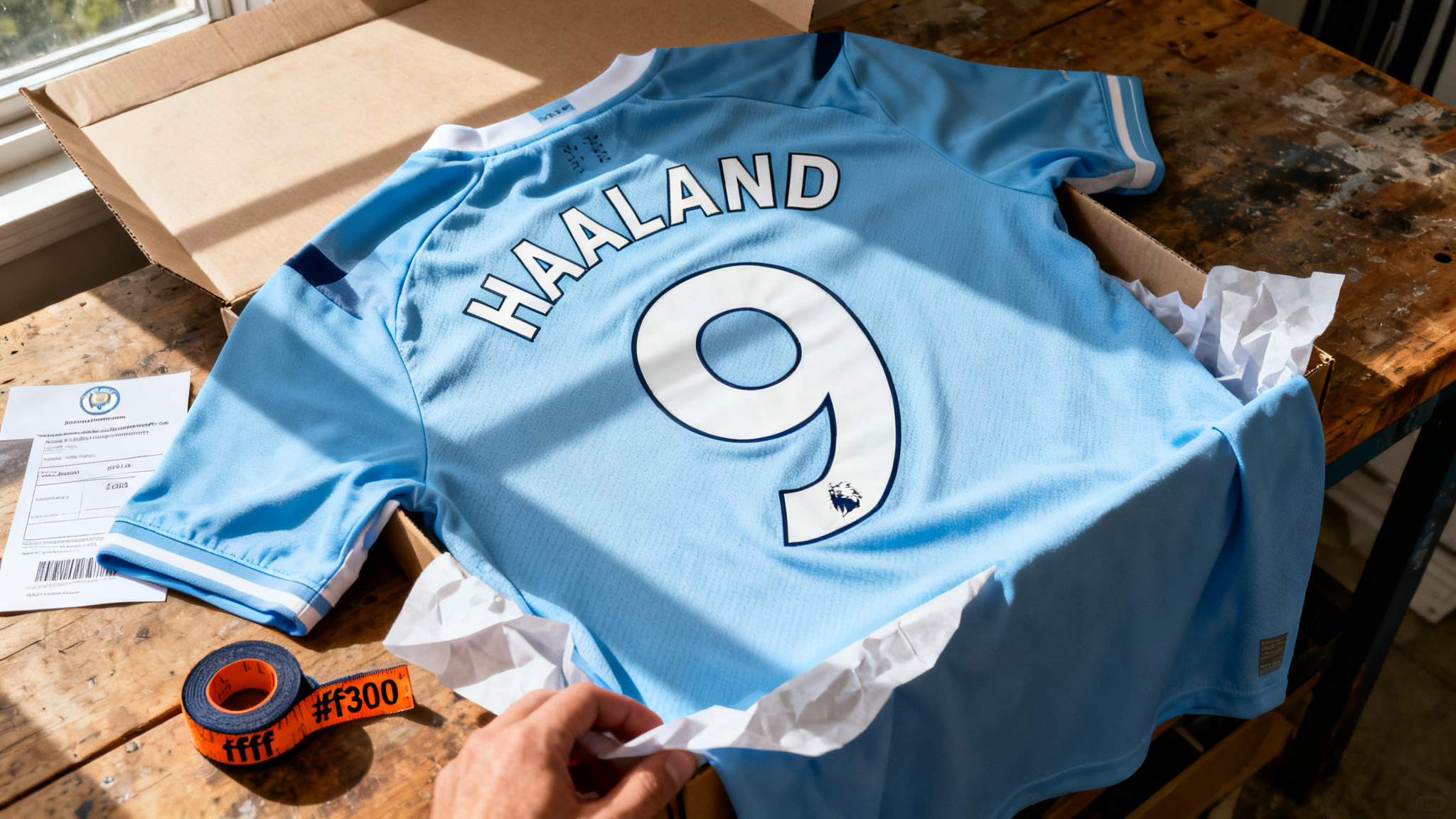
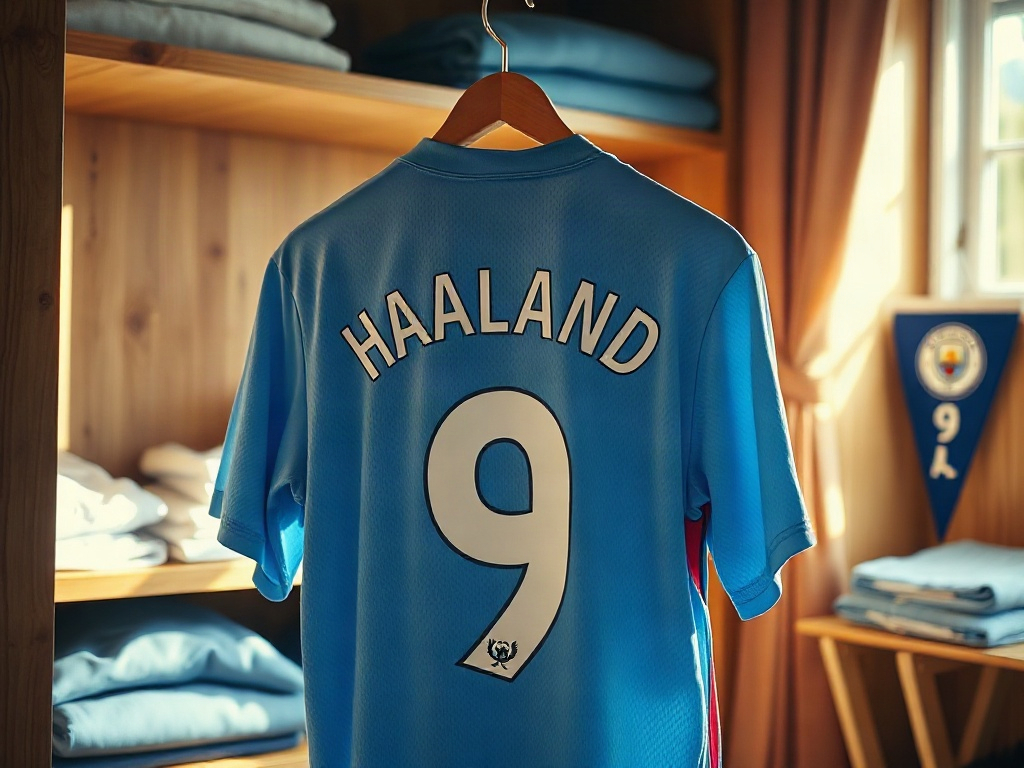
The official Haaland jersey name and number uses all-capitals HAALAND in the licensed Premier League Custom font, centered above the number 9, with no accent marks, no first name, and no substitutions allowed if you want it to read as authentic. Start with the basics, because a surprising number of customized shirts ship with errors that never get caught until the customer holds the finished product up to the light.
Spelling the Name Correctly
His full name is Erling Braut Haaland. On the back of a Manchester City shirt, the official print reads simply HAALAND, all capitals, no accent marks, no first name. That double-A is the first place errors creep in. “HALAND” (single A) shows up more often than you’d expect, particularly on third-party prints where the operator is working from a verbal order rather than a written confirmation. Always request a digital proof before anything is heat-pressed or stitched so you catch that single-A mistake before it becomes permanent.
The Premier League Font
Manchester City jerseys use the Premier League’s official player naming font, which as of the 2023-24 season is the Premier League Custom font supplied by the league to all 20 clubs. It features a bold, slightly condensed uppercase letterform with clean geometric cuts. The number sits directly below the name, centered, in the same type family. This is a licensed font, which means unofficial printers who can’t access it will substitute something that looks close but reads wrong to anyone paying attention. The weight is heavier than Arial Bold. The spacing between letters is tighter than most default settings.
The Number: 9
Erling Haaland wears the number 9 at Manchester City. He took the squad number on joining from Borussia Dortmund in the summer of 2022, paying roughly £51 million (the release clause in his contract). The 9 at City had a complicated recent history before him: Gabriel Jesus wore it from 2017 until leaving for Arsenal in that same 2022 window. Before Jesus, the number passed through several hands during the period when City’s starting striker rotation was fluid. When Haaland claimed the number 9, it felt settled again in a way it hadn’t for years, and the shirt sales reflected that immediately.
If you are customizing a City home, away, or third shirt from any season since 2022-23, the number is 9. No ambiguity there.
Print vs. Embroidery: Which Finish Holds Up
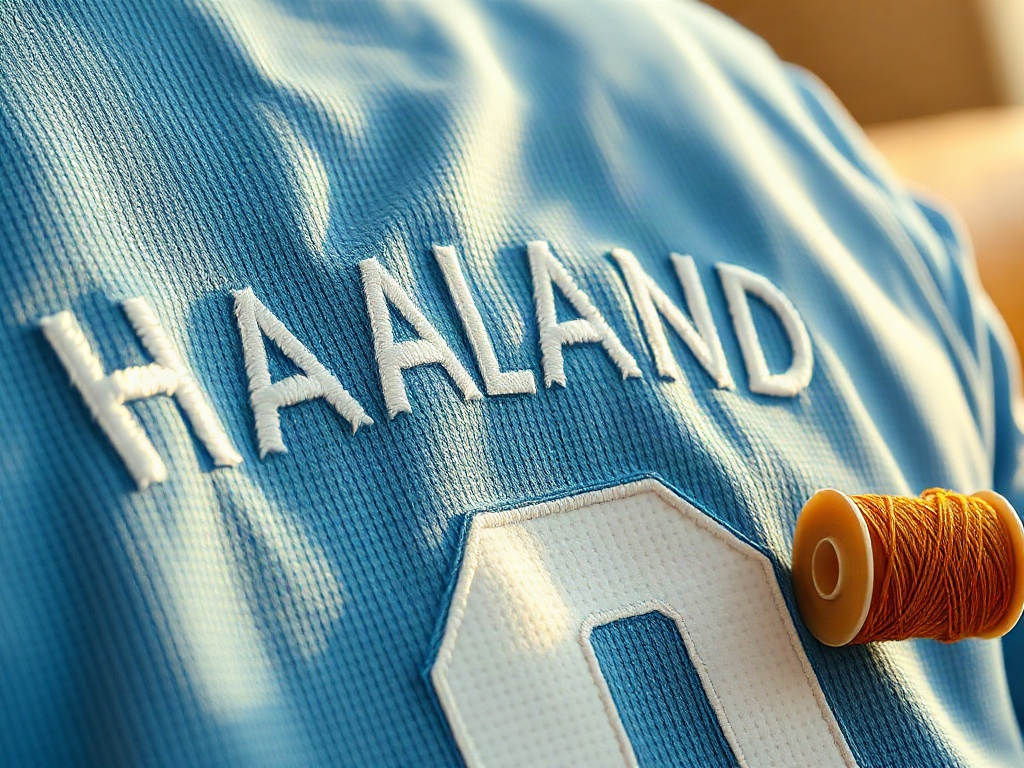
For everyday match-day wear, heat-transfer printing is the right call: it’s lighter, sits flat, and mirrors exactly what licensed club shops apply. For a shirt you plan to keep for a decade or display under glass, embroidery is worth every extra penny because the thread never peels.
You have two main options for applying a name and number to a soccer jersey: heat-transfer printing and embroidery. They behave completely differently over time and under repeated washing.
| Feature | Heat-Transfer Print | Embroidery |
|---|---|---|
| Feel on the shirt | Flat, smooth, barely noticeable | Raised, textured, three-dimensional |
| Durability | 3+ years with correct washing | Lasts as long as the fabric itself |
| Risk over time | Edge peeling if washed hot or tumble-dried | No peeling; thread stays locked in the weave |
| Inside of shirt | Completely smooth | Slight texture (can feel during active wear) |
| Best for | Match-day wear, training use | Collector pieces, framed display, long-term keepsakes |
| Relative cost | Lower | Higher (more time, more craft) |
Heat-Transfer Printing
Most official replica jerseys sold through club shops and licensed retailers use a heat-transfer application. A pre-cut vinyl or flock layer is pressed onto the fabric using heat and pressure, bonding the lettering to the shirt’s surface. When done correctly with quality vinyl and proper temperature control, a heat-transfer application on a polyester jersey holds well for dozens of washes, provided you follow the care instructions: inside out, 30 degrees, no tumble drying.
The failure mode is peeling at the edges, usually starting at the corners of the letters or at the base of the number. This happens fastest when the shirt is washed at high temperatures or tumble-dried. A quality application on a genuine Puma replica, pressed by an authorized printer, should not peel within the first three years of normal use. If yours starts lifting earlier, the application temperature or vinyl grade was likely wrong from the start.
Embroidery
Embroidery uses thread stitched directly into the fabric. It costs more, takes longer, and adds a small amount of weight and stiffness to the back panel. It also does not peel. The thread stays locked into the weave of the shirt, so unless the fabric itself degrades, the lettering stays too. If you are buying a jersey as a collector’s piece, as a display item, or simply as something you intend to wear for a decade, embroidery is worth the premium for exactly that reason.
The trade-off: embroidery adds visible texture on the inside of the shirt, which some people find uncomfortable against the skin during active use. For match-day wear, most fans prefer the flat heat-transfer. For a framed display piece or a prized collection item, embroidered lettering looks sharper under glass and ages with the shirt rather than against it.
Sizing the Name and Number for Your Shirt
Premier League sizing guidelines call for a name strip roughly 7-8 cm tall on adult shirts, with the number below at 20-22 cm: get those dimensions wrong and even a perfect font will look immediately out of place, too bulky on a medium or lost on an XL. Children’s sizes scale down proportionally, running closer to 15-16 cm for the number on a small.
When ordering customization through any third-party printer, ask them to confirm the font size and placement before they press anything. A reputable shop will always offer a digital proof. If they don’t, that’s a signal worth taking seriously.
Adult vs. Youth Shirts
The font and spelling are identical across adult and youth sizes. Only the physical dimensions change. If you are buying for a child, confirm whether the printer uses a youth-scaled template or manually adjusts. Some shops only stock adult transfer sizes and scale them down imprecisely, which produces slightly blurry edges on small shirts because the vinyl wasn’t cut at the correct resolution for the smaller dimensions.
Spotting a Fake: What the Lettering Tells You
Counterfeit City shirts with Haaland printing are common at every price point, and the lettering is usually the fastest way to spot them: the font weight, the color, and the placement are all slightly wrong on fakes, and once you know what to look for, you can’t unsee it.
- Font weight is wrong: Fakes almost always use a lighter letterform. Hold the shirt next to a photo of an official replica and the difference is immediate.
- Color mismatch: On a genuine City home shirt, the name and number are printed in white. On some fakes, it reads as a very slightly warm off-white or cream under natural light. The shade difference is subtle but real.
- Placement is off: On the official Puma template, the name sits centered, roughly 4-5 cm below the collar seam at its lowest point. Fakes frequently place the name too low, crowding the number and leaving too much fabric above.
- Transfer edges are rough: Run your thumb across the edge of a letter on an official print. The edge should be clean, with a very slight raised feel but no rough texture or visible cutting marks. Fake transfers often have uneven, jagged edges you can feel clearly.
- Missing Premier League badge: Since 2016-17, the official Premier League sleeve badge and the player number application are part of the same licensed kit package. If the number is present but the sleeve badges are missing or obviously low-quality, treat the whole shirt with suspicion.
Buying a fully customized authentic replica jersey from a trusted source removes all of this uncertainty at the point of purchase.
Haaland’s Jersey Across City Kits: Home, Away, Third
The number 9 stays constant across every Manchester City kit release, but the lettering color adapts to each shirt’s base color, so always confirm the correct application shade before ordering for an away or third kit: white on sky blue is obvious, but darker bases shift the rules.
Manchester City release three kits per season: home (sky blue), away (varies by season), and third (varies). The name-and-number application uses white lettering on the home shirt and adapts its color on the away and third depending on the base shirt color, always maintaining legibility contrast. The 2024-25 away shirt, which runs in a dark navy colorway, uses the same white lettering as the home. The third shirt in that cycle uses a sky blue application on a darker base.
If you are customizing a specific kit version, confirm the correct lettering color before ordering. White on sky blue (home) is straightforward. Away and third kits have changed color every season since Haaland arrived, so always cross-reference the specific year of your shirt.
Fans looking at the full range of Manchester City jerseys available across seasons will find both official replica versions and high-quality alternatives with the correct name and number configurations for each colorway.
Frequently Asked Questions about the Haaland Jersey Name and Number
What number does Haaland wear at Manchester City?
Erling Haaland wears the number 9 at Manchester City. He claimed the squad number when he joined the club from Borussia Dortmund in July 2022 and has worn it continuously since. All City replica shirts customized with his name use the number 9.
How is “HAALAND” spelled on the official jersey?
The official Premier League application uses all capitals: HAALAND. That is two A’s, no accent marks, no first name. Single-A (“HALAND”) is a common error on unofficial prints. Always request a digital proof before confirming your customization order.
What font is used on Premier League jerseys for player names?
Manchester City and all other Premier League clubs use the official Premier League Custom font, a bold condensed uppercase letterform supplied under license by the league. Unauthorized printers cannot legally access this font and typically substitute a similar-looking alternative that reads slightly differently to careful eyes.
Should I choose print or embroidery for a Haaland name and number?
For regular match-day wear, heat-transfer printing is the standard and practical choice. It’s lighter, sits flat, and mirrors what official club shops apply. For a collector’s piece, display jersey, or a shirt you intend to keep long-term, embroidered lettering is more durable and ages better. Embroidery costs more and takes longer, but the finish is permanent in a way that heat-transfer never quite is.
Can I add the Haaland name and number to any Manchester City shirt, including older seasons?
Technically yes, but the font and number format are specific to the Premier League era (2022 onward). Applying a modern Premier League font to a shirt from, say, the 2019-20 season creates an anachronism that will read as wrong to any knowledgeable eye. If you want a Haaland shirt from a specific historical season, use the font and format that actually existed on that season’s official print. Some collectors retrofit modern names onto vintage shirts deliberately as a creative choice, which is a different thing entirely from buying a customized replica.
How do I know if a customized Haaland jersey is from a trustworthy source?
Look for shops that offer a digital proof before pressing, can confirm the Premier League Custom font is used, and name their vinyl grade or embroidery thread count. Any reputable printer will welcome those questions. Vague answers about “official-style” fonts or refusal to provide a proof before payment are both signs to walk away.
Caring for a Customized Jersey So the Lettering Lasts
The name and number on your shirt can outlast the fabric itself if you follow five simple washing rules: inside out, 30 degrees maximum, no tumble dryer, no direct iron contact, and stored without heavy weight pressing down on the letters. Skip even one of these consistently and the edge peel starts far sooner than it should.
- Wash inside out, every single time. The drum of a washing machine is abrasive to the transfer surface.
- Use 30 degrees Celsius maximum. Heat breaks down the bonding layer in heat-transfer applications. Cold or cool washes extend life significantly.
- No tumble dryer. The combined heat and tumbling action is the fastest way to lift a transfer at the edges. Air dry flat or on a hanger.
- No ironing directly over the letters. If you need to press the shirt, iron on the reverse side only, or use a cloth barrier between the iron and the transfer.
- Store folded with the print facing inward, or on a hanger. Stacking with the letters pressed against other surfaces under weight puts long-term pressure on the transfer layer.
Follow these five points and a correctly applied name-and-number set will stay sharp through years of regular wear. Ignore them and even a premium-quality application can start showing edge peel within a single season.
If you are starting from the right base, with a genuine replica shirt and accurate lettering applied by an experienced shop, the result should feel exactly as it should: like you pulled it straight from an authorized club source. That is the standard everything should be measured against, and it is entirely achievable when you know what to look for before the shirt ever arrives at your door.
The shop
Find your jersey
Clubs, national teams, concept and retro designs. With your name and number, if you like.
- Free shipping from $65
- 3 jerseys = 1 free
- 14-day returns