SPECIAL OFFER BUY 3 JERSEYS = GET 1 FREE

Soccer Jersey Sizing: How to Get the Right Fit Every Time
Getting the right soccer jersey size is harder than it looks. This guide covers how to measure yourself accurately, how sizing differs across Nike, Adidas, and Puma, what to expect from vintage versus modern cuts, and how to pick between authentic and replica fits so your next jersey feels right from the first wear.
In this article9 sections
- Why Soccer Jersey Sizing Is Not Like Normal Clothing
- How to Measure Yourself for a Soccer Jersey
- Brand-by-Brand Soccer Jersey Size Guide
- Vintage Jersey Sizing: A Completely Different Conversation
- How Kids’ and Women’s Soccer Jersey Sizing Works
- Sizing for Layering Over a Base Layer
- How to Read a Size Chart Without Being Misled
- Frequently Asked Questions about Soccer Jersey Sizing
- The Right Size Means the Jersey Actually Gets Worn
The jersey arrived. You tore open the box, held it up, and something was off. Too long in the body. Too tight across the shoulders. Sleeves that hit your wrist wrong. It goes back in the bag, and now you have to navigate a return. That whole situation is avoidable, and it happens to more people than you’d think, because soccer jersey sizing is not as straightforward as a regular T-shirt.
Kit dimensions vary by brand, by era, by cut style, and sometimes by the specific club. A size Large from Nike in 2024 is a different garment than a size Large from Adidas in 2004. Knowing that one fact alone will save you time and disappointment.
Why Soccer Jersey Sizing Is Not Like Normal Clothing
Soccer jerseys are performance garments built for athletes first, and that design intent shapes every measurement on the tag: the chest is cut closer, the rear hem drops longer than a standard tee, and the shoulder seam sits precisely on the shoulder point in ways casual shirts never bother with. Even fan replicas carry that heritage, which is why applying T-shirt logic to kit buying leads to so many returns.
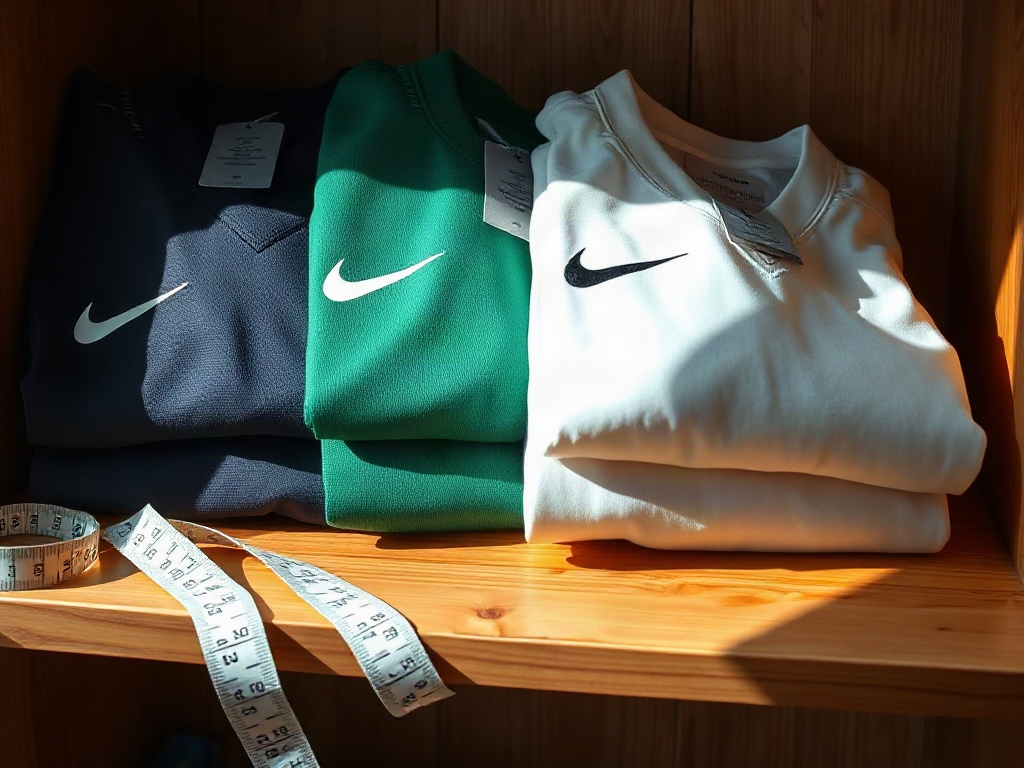
Football kits are performance garments first. Even replicas sold to fans carry the heritage of that design intent. The fit is usually cut closer to the body than a standard crew-neck tee, with a slightly longer hem at the back (to stay tucked or to drape cleanly when untucked). That rear hem drop is something buyers miss constantly when ordering blind.
There are also two fundamentally different products in the market, and they follow different size logic.
Authentic Jerseys vs. Replica Jerseys: The Size Difference
An authentic (player-issue) jersey is built around the body of an athlete. The chest is a touch wider, the fabric is lighter and stretches with movement, and the overall silhouette is slim and performance-mapped. If you have a broader frame or prefer a more relaxed fit, authentic cuts can feel restrictive even in larger sizes.
A replica (fan version) is cut with a bit more room through the torso. The fabric is heavier and less elastic. It sits more like a casual shirt. Most people buying for everyday wear or matchday use are better served by the replica fit, unless you specifically want that athletic profile.
The price gap between the two is real: authentic versions typically run $30 to $60 more depending on the club and season. The sizing gap is less talked about, but it matters just as much if fit is your priority.
How to Measure Yourself for a Soccer Jersey
Three measurements control your jersey fit: chest circumference, torso length from shoulder to hem, and shoulder width across the back. Get all three before you open any size chart, because no single number tells the full story. Once you have them written down, they travel with you to every brand’s chart and every era of kit you consider buying.
- Chest: measure around the fullest part of your chest, tape flat against your skin, arms relaxed at your sides. This is the number that controls everything.
- Torso length: from the top of your shoulder down to where you want the hem to sit. Most jerseys run 28 to 32 inches in a men’s medium, but that varies.
- Shoulder width: from the outer edge of one shoulder to the other, across your back. A seam that sits even half an inch off your shoulder point will feel wrong all day.
Write those three numbers down. They travel with you to every size chart.
Brand-by-Brand Soccer Jersey Size Guide
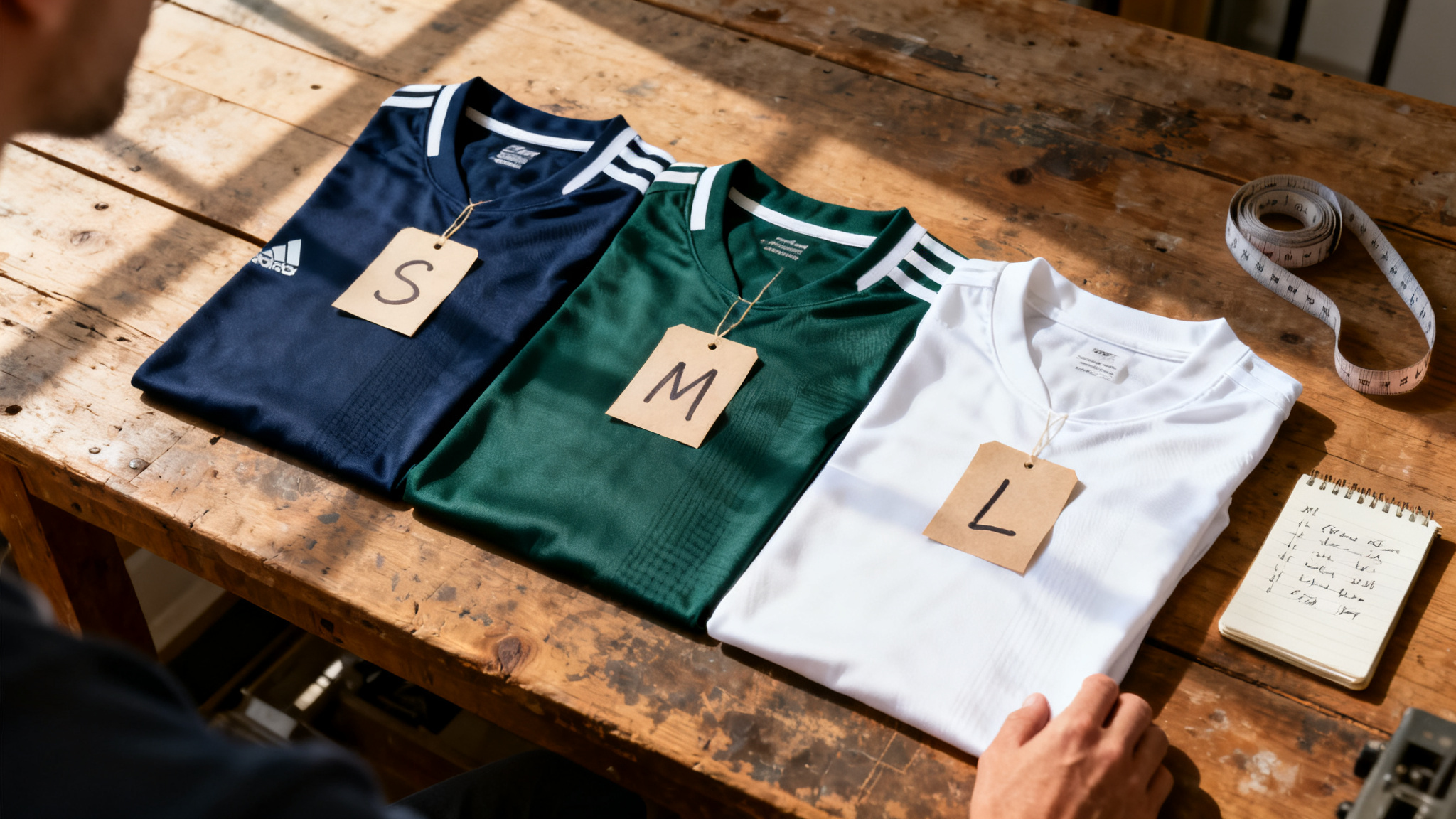
Nike, Adidas, and Puma each run their own chest measurement ranges, and they do not align neatly: Nike tends to run one inch larger per label than Adidas, which means a buyer who fits a comfortable Adidas Large will often sit squarely in a Nike Medium. Understanding that gap before you order is the simplest way to avoid the wrong size arriving at your door.
Every major kit manufacturer runs their own size logic. Here is how the main players compare for a standard men’s fit, based on chest measurements in inches.
| Size | Nike (inches) | Adidas (inches) | Puma (inches) |
|---|---|---|---|
| S | 35-37 | 34-36 | 34-36 |
| M | 38-40 | 37-39 | 37-39 |
| L | 41-43 | 40-42 | 40-43 |
| XL | 44-46 | 43-45 | 44-47 |
| XXL | 47-49 | 46-48 | 48-51 |
Nike runs slightly larger than Adidas at each label. If you are on the boundary between an Adidas M and L, you are almost certainly a comfortable M in Nike. Puma sits closer to Adidas through the mid-range but opens up notably at XXL, making it one of the better fits for buyers who carry their size in the chest rather than the shoulders.
What About Kappa, Hummel, and Smaller Kit Manufacturers?
Kappa tends to cut narrow through the torso, particularly on their older Italian-heritage styles. If you have a broad back or wide shoulders, go one size up from what you’d normally order in Nike. Hummel runs true to European sizing, which means slightly slimmer than US expectations. Smaller manufacturers producing concept kits and independent designs vary even more: always check their specific brand chart rather than applying a generic rule.
Vintage Jersey Sizing: A Completely Different Conversation
Vintage kits from the 1980s and early 1990s run consistently smaller and shorter than their modern equivalents, because they were made from cotton-heavy fabrics with little stretch, cut to athletic proportions that were narrower in the shoulder and shorter in the body than today’s standards. If you are buying genuine vintage, treat every size label as a starting point, not a guarantee.
This is where sizing knowledge really separates confident buyers from frustrated ones. Kits from the 1980s and early 1990s were made in a different era of garment manufacturing. Cotton-heavy fabrications with very little stretch. Sizing labels that used numbers instead of S/M/L (a “38” referred to chest in inches, roughly). Proportions built around different athletic body norms.
A vintage 1990 World Cup kit labeled “L” from that period will fit most modern medium wearers. The shoulders are narrower. The body is shorter. The sleeves are cut with less length. If you are buying a genuine vintage piece, treat every size label as a starting point, not a guarantee. Ask the seller for actual flat-lay measurements: chest across (multiply by 2 for total chest), length from shoulder to hem, and sleeve from center back seam to cuff.
The oversized streetwear trend of the mid-2020s has pushed some buyers to intentionally seek larger vintage cuts, wearing a kit that runs two sizes over their normal fit for a dropped-shoulder, boxy look. If that is your aim, you still need the flat measurements, just to confirm the chest width is wide enough and the shoulders aren’t so narrow they create a crumpled seam.
How Kids’ and Women’s Soccer Jersey Sizing Works
Children’s kits are sized by height range rather than body measurements, and women’s cuts are a genuinely different pattern from men’s kits: shorter in the torso, narrower at the shoulder, and shaped through the waist. Using a men’s size chart for either group produces the wrong result almost every time. Here is how to read each category correctly.
Children’s kits from the major manufacturers run by age and height rather than by body measurements. Here is the practical problem: children are individuals, not averages. A 10-year-old at the tall end of their age range can easily need a kit labeled for 12-13 years. Always cross-reference the height range on the brand’s chart with your child’s actual height, not their age.
Women’s cuts became standard across Premier League and Champions League replica lines from around 2019 onwards. Before that, women buying football jerseys either wore men’s kits or sized down to youth ranges. Women’s specific cuts are shorter in the torso, narrower through the shoulders, and shaped with some taper through the waist. They are not simply smaller men’s kits, and they fit very differently if you try to use a men’s size chart to pick them.
Sizing for Layering Over a Base Layer
If you wear a jersey over a thermal base layer for cold matchdays, add roughly one inch to your chest measurement before consulting any size chart, and seriously consider going one full size up from your usual choice, because most kit patterns have very little ease built in for layering. Getting this wrong on a freezing January matchday is exactly as uncomfortable as it sounds.
Some buyers pick up football jerseys across multiple eras and keep one size for summer wear and one sized up for layered autumn and winter matchdays. It sounds like an edge case, but once you’ve worn a jersey that fits perfectly over a base layer, you understand the logic immediately.
How to Read a Size Chart Without Being Misled
The most common size chart mistake is confusing “to fit” measurements with “actual garment” measurements: a jersey listed as “to fit 40 inches” will typically measure 42-44 inches flat to allow for ease of movement, while an “actual garment” measurement of 40 inches flat would be genuinely tight on a 40-inch chest. Read the chart header carefully before you apply any numbers.
Most official brand size charts show measurements in centimeters. If you’ve measured in inches (which is more natural for a lot of buyers in the UK and US), convert before you look: 1 inch is 2.54 cm. A 40-inch chest is 101.6 cm, so rounding to 102 cm is fine.
Third-party retailers and independent concept jersey shops sometimes publish their own size guides that differ from the manufacturer’s original spec, particularly if they’ve done a custom run. Those guides take precedence over the brand’s generic chart because the garment was made to a specific pattern. Look for the shop’s own sizing notes first, and treat the brand chart as a fallback only.
For anyone building a kit collection rather than buying a single jersey, it is worth keeping a simple record: the brand, the size label you ordered, the actual chest measurement from the tag (if available), and how it fits. Within three or four purchases you’ll have a reliable personal reference instead of second-guessing every order. Fans who are serious about finding the right football kit fit for their body type swear by this habit.
🧾
Looking for a jersey that fits by design?
The concept jersey collection is built on precise pattern specifications. Every garment ships with a detailed flat-lay measurement guide so you can match numbers to your own tape measure before you buy, not after.
Frequently Asked Questions about Soccer Jersey Sizing
Do soccer jerseys run small or true to size?
It depends on the brand and the cut. Nike tends to run slightly generous. Adidas and Kappa run closer to European slim sizing, which can feel small to buyers used to US casual wear. Authentic (player-issue) cuts run smaller than replica versions in the same size label. Always measure your chest and check the specific chart for the jersey you’re buying.
Should I size up for a soccer jersey?
If you are between sizes, size up for shoulder fit. If you plan to wear a base layer underneath, size up for chest room. If you prefer a looser, more casual look rather than an athletic fit, sizing up by one is usually right. If you are buying an authentic cut for a slim athletic fit, stay at your measured size or even size down.
Are vintage soccer jerseys smaller than modern ones?
Generally, yes. Cotton-heavy kits from the 1980s and early 1990s tend to run smaller and shorter than modern equivalents. Sizing labels from that era used chest measurements in inches rather than S/M/L labels, so a “42” label is not the same as a modern XL. Always request flat-lay measurements before buying any vintage piece.
What is the difference between an authentic and replica soccer jersey size?
Authentic jerseys are cut for athletes: slimmer through the torso, lighter fabric with more stretch, and a close athletic profile. Replica jerseys have more room through the body and use heavier, less elastic fabric. In practice, many buyers find they need to go one size larger in an authentic cut compared to what they’d order in a replica to achieve a similar level of comfort.
How do I size a soccer jersey for a child?
Use the brand’s height range, not the age label. Children grow at different rates, so a 10-year-old who is tall for their age may need a kit labeled 12-13 years. Cross-reference height with the brand’s specific chart every time, because sizing conventions differ between manufacturers even in the same product era.
How do I convert jersey sizes between US and European measurements?
Multiply your chest measurement in inches by 2.54 to get centimeters. A 40-inch chest equals 101.6 cm, so round to 102 cm when reading a European chart. Remember that European size charts typically show “to fit” measurements rather than garment measurements, so the jersey itself will be slightly wider than the number listed.
The Right Size Means the Jersey Actually Gets Worn
A kit that sits in a drawer because the fit is wrong is a quiet disappointment, and it is entirely avoidable: one round of measuring, the right chart for the right brand and cut, and a clear understanding of whether you are buying modern or vintage is all it takes to get a jersey you actually reach for. That habit changes how you shop for kits permanently.
A kit that sits in a drawer because the fit is wrong is a quiet disappointment. The whole point of owning a jersey is that you reach for it without thinking, on matchdays and ordinary Saturdays alike. Getting the size right the first time, by measuring once, checking the right chart for the right brand and cut, and accounting for whether you’re buying modern or vintage, is the difference between a jersey you love and one that just takes up space.
Fans who take the time to browse concept football jerseys from independent designers often find sizing charts that are more detailed than anything the big brands publish, because smaller-run garments are made to precise specifications and the designers know their customer is paying attention. That precision is one of the reasons the independent kit world has grown so steadily. The detail is there if you look for it.
Hold the jersey up to the light before you commit to a size. Check your numbers. Trust the measurements over the label. That habit alone will make you a better kit buyer every time. ⚽
The shop
Find your jersey
Clubs, national teams, concept and retro designs. With your name and number, if you like.
- Free shipping from $65
- 3 jerseys = 1 free
- 14-day returns